Answer Engine Optimization Playbook: How to get cited by ChatGPT, Claude and Perplexity [2025]
Nearly half of B2B buyers use AI for vendor research, yet most companies remain invisible in ChatGPT and Claude responses. Learn how Discovered Labs' CITABLE framework helps B2B brands get cited by AI.
Growth marketer and B2B demand specialist with expertise in AI search optimisation - I've worked with 50+ firms, scaled some to 8-figure ARR, and managed $400k+/mo budgets.
July 27, 2026
Published: October 28, 2025|Updated: July 27, 2026
11 mins
Updated on 18 May 2026
TL;DR: Nearly half of B2B buyers now use AI for vendor research with ChatGPT alone reaching 700 million weekly users. Yet most B2B companies remain invisible when AI generates vendor recommendations. Discovered Labs' CITABLE framework, a 7-part methodology for AI citation optimization, combined with daily content production ensures your brand appears in ChatGPT, Claude, and Perplexity responses. AI-driven traffic currently represents 2-6% of total organic traffic and is growing 40% monthly, with our clients seeing 2.4x higher conversion rates than traditional search.
The challenge is that traditional SEO strategies don't one-to-one translate to AI visibility. Your website can rank first on Google for every target keyword while smaller competitors with less domain authority capture more share of voice in AI answers.
This playbook reveals how to measure your AI visibility using Discovered Labs' CITABLE framework, identify where competitors dominate, and implement the daily optimization that drives measurable pipeline growth in as little as a few weeks.
Why AI search visibility is the new surface area for B2B companies#
How B2B buyers discover and evaluate vendors is changing once again. Nearly half of B2B buyers now use AI for vendor research, asking ChatGPT, Claude, or Perplexity for recommendations instead of clicking through Google results. Early data shows AI-driven discovery currently contributes 2-6% of B2B organic traffic - a small but quickly 40% MoM growing segment that converts significantly better than traditional search.
The shift in buyer behavior: from Google to AI assistants#
B2B buyers have moved from traditional search engines to AI-powered answer engines. When a prospect asks "What's the best project management software for remote teams?" they receive a curated response naming 3-5 vendors with specific reasons why each fits - not a list of generic blue links to click through.
If your brand isn't mentioned in that AI-generated answer, you could miss out on the vendor shortlist: The prospect never visits your website, never enters your funnel, and doesn’t become a qualified lead. The worst part about this is you might never know this is happening without the right measurement in place.
The cost of invisibility: losing deals before sales conversations start#
Your current SEO agency reports "page 1 rankings" and "domain authority improvements" while your clicks and qualified pipeline are on a downtrend. They're optimizing for metrics that mattered in 2023, not for how buyers research solutions today. When you ask about AI visibility, they say "we're looking into that" or "SEO covers it" - but there’s no method to the madness. Because the pain of losses in organic traffic isn’t as visceral as other channels like paid media, it goes under the radar.
We’ve seen this happen a few times. One B2B SaaS company increased AI-referred trials 4x from 550 to 2,300+ in four weeks through our AEO strategy, delivering 600% citation uplift across ChatGPT, Claude, and Perplexity. More importantly, those AI-referred trials converted to paid customers at a higher rate than traditional organic search leads, directly impacting the company’s bottom line.
The conversion advantage: AI-sourced traffic converts 2.4x higher#
The best part about traffic referred from AI assistants is it converts better. Our client data consistently shows AI-sourced traffic converting 2.4x to 2.6x higher than traditional search, with B2B SaaS seeing conversion rates of 15.2% compared to 8.9% for Google organic traffic. This increase in performance stems from AI's ability to pre-qualify prospects, match intent precisely, and provide contextual relevance before a user even clicks. It’s like receiving a personalized referral from a peer rather than another cold pitch in your inbox where the sender hasn’t taken the time to understand your needs.
Diagnosing your AI discoverability: what to measure and how#
Before optimizing for AI visibility, you need to understand where you stand today. Most B2B companies have no systematic way to track whether AI platforms cite them versus competitors, making it impossible to prove ROI or progress to leadership.
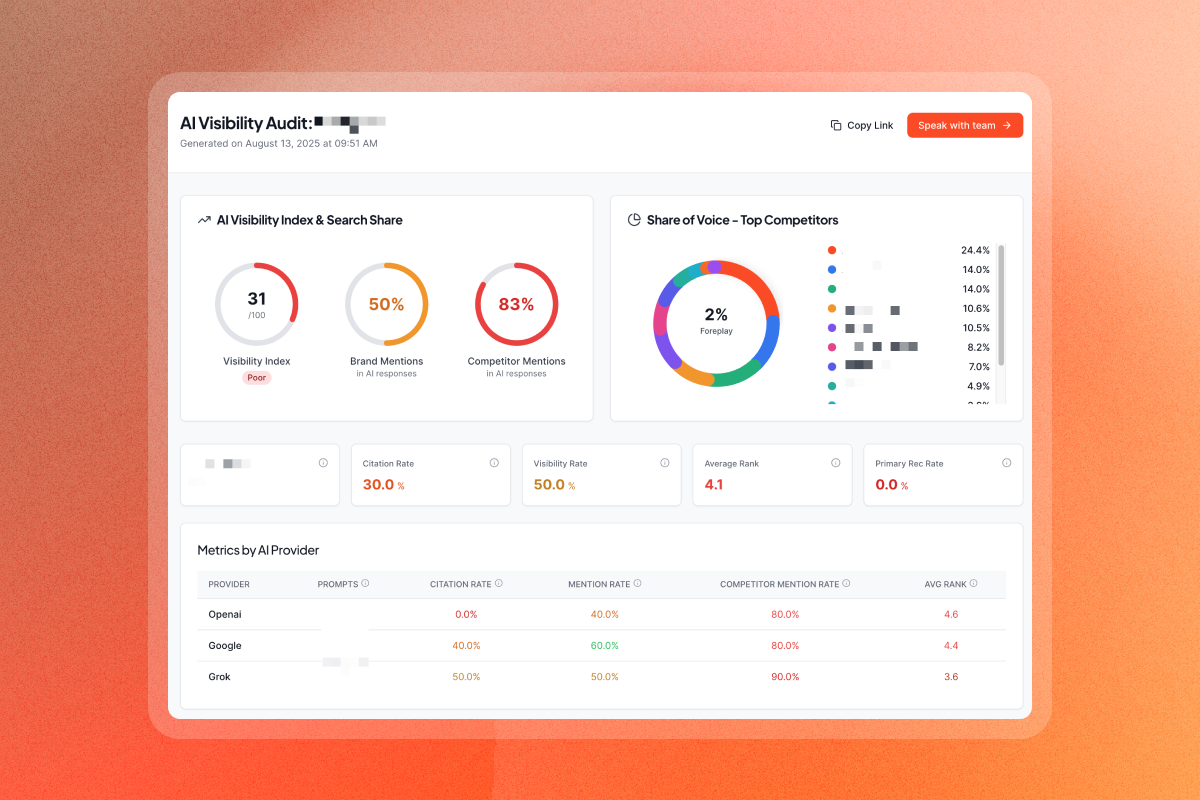
Internal tool we built for AEO audits
Beyond keyword rankings: tracking AI citations and share of voice#
Traditional SEO metrics like keyword rankings and domain authority no longer capture visibility when prospects use AI to find vendors. You need new metrics that reflect how AI models surface and cite your brand:
Citation volume and uplift tracks how many times AI platforms cite your brand as a source and the percentage increase over time. Discovered Labs monitors brand presence across ChatGPT, Claude, Perplexity, Google AI Overviews, and Microsoft Copilot, providing weekly dashboards showing citation trends and competitive benchmarking.
Share of voice measures how often your brand appears in AI-generated answers compared to competitors. For example, if competitors are cited in 65% of relevant AI answers while you appear in 0%, that 65-point gap represents lost qualified pipeline.
Citation quality evaluates the depth and specificity of information shared in AI answers. LLMs are only as good as the information they pull - so the objective here is to make sure they’re positioning you well against competitors and you’re preventing outdated or inaccurate information being provided to ideal buyers.
The AI search visibility audit: benchmarking your current presence#
When auditing your AI search visibility aim to test several hundred queries across ChatGPT, Claude, Perplexity, Google AI Overviews, and Microsoft Copilot. With clients, we document exactly which 3-5 competitors are cited for each query, where you're completely invisible, and which gaps cost you the most qualified pipeline. These insights inform the AEO strategy.
We combine this audit with a traditional technical SEO audit to uncover foundational issues like broken schema markup, duplicate content, or poor internal linking that hinder AI's ability to process your content.
The Discovered Labs CITABLE framework: engineering content for AI citation#
We noticed very quickly that traditional SEO content optimized for keyword density and backlinks doesn't earn AI citations, so we developed the CITABLE framework. This framework is grounded in research, some of which from the AI companies themselves, and helps us ensure every piece of content hits the right signals to increase the chances of passage-level retrieval from LLMs.
Here’s a summary of the framework:
Clear entity & structure: making AI understand what you are#
AI models need immediate clarity about what your product/service is, who uses it, and when it applies. Lead every page with a 2-3 sentence Bottom Line Up Front (BLUF) that defines the topic without marketing fluff. For example, instead of "revolutionary platform transforming how teams work," write "Acme is project management software for remote engineering teams. It combines sprint planning, code reviews, and async standups in one tool. Teams of 5-50 developers use it to ship faster without more meetings."
Intent architecture: answering the full question cluster#
When buyers ask AI about your category, they rarely stop at one question. AI systems perform "query fan-out" breaking initial questions into sub-queries about pricing, alternatives, integrations, and use cases. Map your content to address 5-7 adjacent intents on every page, using tools like AlsoAsked to identify the exact question clusters in your space.
Structure pages with the primary question as your H1 and the direct answer within the first 100 words. Then systematically address related intents through dedicated sections: "How [product] compares to alternatives," "Who shouldn't use [product]," "Integration requirements and compatibility." This hub-and-spoke architecture keeps AI responses focused on your content rather than pulling from competitors.
Third-party validation: building trust beyond your domain#
ChatGPT search prioritizes reputable sources such as Wikipedia, Reddit and G2, making third-party validation important for AI visibility. Your own website claiming you're "the best" carries minimal weight because AI models trust external validation from high-trusted, third-party domains more.
Improve you third-party presence: establish Wikipedia and Wikidata entries, launch quarterly review campaigns on G2/Capterra/TrustRadius targeting specific customer segments, and seed mentions in industry publications. Every piece of owned content should reference and link to these external validations. When TechCrunch mentions your Series A or G2 reviews praise your customer support, these become the proof points AI systems cite. Weave them into every piece of content.
Google's AGREE research shows models cite better when claims are explicitly grounded. Every assertion needs evidence, not vague social proof but specific, verifiable facts with source links. Start answers with 40-60 word direct responses that could work as featured snippets, then support with inline citations linking to authoritative third parties.
Create "quotable facts" throughout your content which are standalone 1-2 sentence statements with specific numbers or outcomes. Instead of "customers see significant improvements," write "The average customer reduces deployment time from 45 to 12 minutes after implementing our CI/CD pipeline (State of DevOps Report, 2025)." These grounded, specific claims are what AI systems confidently cite.
Block-structured for RAG: optimizing for retrieval systems#
Modern AI search uses Retrieval-Augmented Generation (RAG), chunking content into segments before processing. Structure content in 200-400 word self-contained blocks, each answering one specific sub-question completely. This isn't about keyword stuffing, it's about making each section independently valuable for extraction.
Format for AI consumption: add TL;DR boxes summarizing key points, use bullet lists for features or benefits, create comparison tables for competitive analysis, and include FAQ sections for common objections. Contextual retrieval and hybrid search (BM25 + embeddings) reward clean, specific text, so avoid walls of text or sections that require reading previous paragraphs for context.
AI systems heavily weight recency, especially for dynamic topics like pricing, features, or market positions. Include "Last updated" timestamps both in-page and in schema markup. But freshness alone isn't enough, information must be consistent across every touchpoint where AI might encounter your brand.
Audit quarterly for consistency: ensure the same pricing appears on your website, G2 profile, partner directories, and press releases. Conflicting information is a top negative factor for AI visibility. If your website says "$99/month" but TechCrunch reported "$79/month" last year, AI models may skip citing you entirely due to uncertainty. Set up monitoring for your key facts across the web and fix discrepancies immediately.
Entity graph & schema: building explicit relationships#
AI systems understand the world through entity relationships: who competes with whom, what integrates with what, which companies use which tools. Make these relationships explicit in your copy: "Alternative to Jira for agile teams," "Integrates with Slack, GitHub, and Linear," "Used by Spotify, Airbnb, and Notion."
Implement structured data that matches visible content exactly: Organization, Product, FAQPage, and HowTo schemas are particularly valuable. But schema alone isn't magic. Google says there's no special schema required for AI Overviews/AI Mode, so it’s just solid fundamentals. The real value comes from making entity relationships clear in both human-readable content and machine-readable markup, creating multiple signals AI systems can cross-reference for confidence.
Daily content production: the engine of AI visibility#
Our somewhat hot take is that in the era of AI quantity does matter. You’re no longer trying to rank a whole page, covering an individual topic, in a determined position within the SERP. From an AEO perspective each piece of content could have 5-10 “worthy” passages to be extracted and there is no fixed position or rank for these passages because of how reasoning chains and memory embedding works - two users could have similar queries but receive unique answers. In short, the need for rich content has increased significantly. LLMs are information hoovers.
AI platforms continuously update their algorithms and training data. A daily publishing cadence ensures your brand maintains fresh signals that AI models recognize and prioritize. Think of it like compounding interest: consistent small deposits of optimized content yield substantial gains over time. Publishing 20-25 pieces per month creates exponentially more AI citation opportunities than publishing 4-8 pieces. Miss a day or two, and you lose momentum on that compound growth.
For a recent case study of ours we published 66 articles in one month. Not only did it significantly increase the number of customers this client got from AI search but we also outperformed their SEO agency by 3x in traditional SERP metrics with an avg. position on page 1 compared to their page 3.
We use a human-in-the-loop workflow that combines AI efficiency with expert oversight. Every piece is built on the CITABLE framework, ensuring content is both genuinely useful for human readers and optimized for AI citation. Each piece captures a specific buyer query and includes the clarity, verification signals, and entity structure AI models require for confident citation.
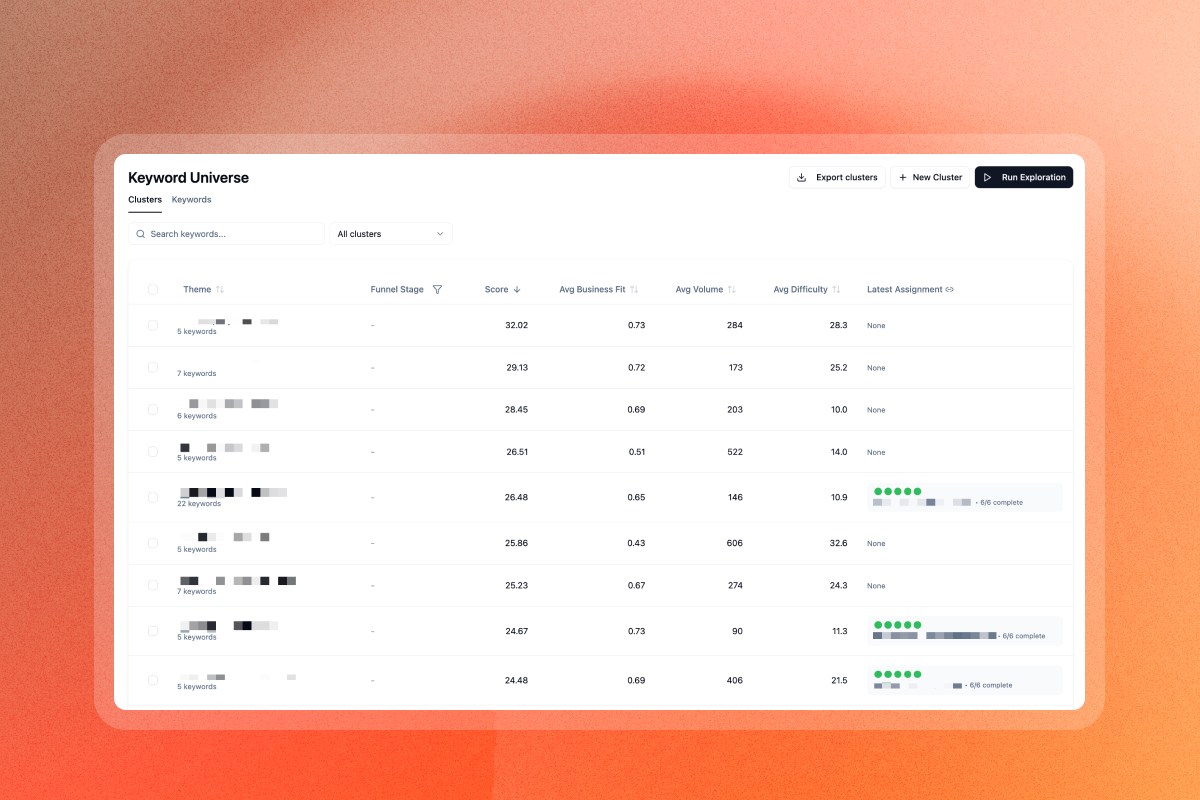
We use AI to assist with keyword clusters and mapping.
Balancing human usefulness with AI citation signals#
Effective AEO content serves two audiences: human readers seeking valuable insights and AI models looking for clear, verifiable information to cite. Our approach doesn't sacrifice one for the other. We structure content for direct answer extraction while ensuring it remains engaging and actionable. Use clear headings, concise summaries, and specific examples that both audiences value. When content ranks well in AI citations, it typically also performs well with human readers because both prioritize clarity, accuracy, and useful information delivered efficiently.
Measuring AI visibility isn't valuable unless it ties to business outcomes. Marketing Leaders need clear, data-backed updates demonstrating strategic adaptation, early wins, and ROI projections.
Weekly citation tracking and competitive benchmarking#
We recommend a weekly cadence of AEO measurement to understand how your leading metrics like mention rate, citation rate and share of voice are evolving over time as well as how competitors are tending. See how Discovered Labs measures AI visibility for the cadence and methodology we use.
Attributing AI-referred MQLs and pipeline contribution#
AI-driven traffic can often appear as direct traffic or branded searches in traditional analytics, making attribution a challenge. Here’s how we approach this:
Track AI-referred traffic in GA4 using regex
Monitor AI-like queries in GSC using regex
Use self-reported attribution to understand how leads discovered you (highly recommend)
Monitoring what content is creating the biggest impact#
As part of your AI visibility audits ensure you keep an eye on citations. We like to bucket them into competitor owned, competitor earned, company owned and company earned, using a playbook for each. For example if we notice a lot of competitor earned citations come from a particular subreddit, we’ll try to shape the narrative there.
Also you want to know what pieces of new content are being cited in AI answers so you can identify outlier formats or angles.
Discovered Labs gets B2B companies cited and chosen by AI search platforms through daily content production optimized specifically for Large Language Model retrieval. We're purpose-built for the era where nearly half of B2B buyers use AI for vendor research.
Schedule a free AI Search Visibility Audit with Discovered Labs today. We’ll test buyer queries across the main AI models and show you exactly where the opportunities are.
How long does it take to see measurable AI visibility improvements? Initial AI citations typically appear in 1-2 weeks after implementing the CITABLE framework and daily publishing. Measurable pipeline impact showing 3-4x increases in AI-referred MQLs takes 3-4 months of consistent optimization.
What's the difference between traditional SEO and AI search visibility? Traditional SEO optimizes for ranking in search result lists. AI search visibility optimizes for citation within AI-generated answers, requiring different content structure, verification signals, and trust indicators.
Which AI platforms should B2B SaaS companies track? Prioritize ChatGPT, Claude, Perplexity, Google AI Overviews, and Microsoft Copilot. Distinct platform preferences for content formats and authority signals require tailored optimization approaches.
How do I attribute pipeline to AI-driven traffic? Implement tagged UTM parameters in analytics, create dedicated GA4 views for AI referrals, and integrate tracking with your CRM to measure AI-influenced opportunities separately.
What causes sudden drops in AI search visibility? Common causes include algorithm changes by AI platforms, competitors publishing better-optimized content, negative sentiment or inaccurate brand mentions, and technical SEO issues blocking AI crawlers.
Answer Engine Optimization (AEO): The practice of optimizing content to be cited by AI search platforms like ChatGPT, Claude, and Perplexity, distinct from traditional search engine ranking optimization.
Citation rate: The frequency with which a brand or its content is referenced by AI search platforms in response to relevant queries, typically expressed as a percentage of target queries where the brand appears.
Share of voice: A metric comparing a brand's citation rate against competitors across a set of buyer-intent queries, revealing competitive positioning in AI-generated recommendations.
CITABLE framework: Discovered Labs' proprietary 7-part methodology for engineering content that Large Language Models can confidently cite, encompassing Clarity, Identity, Third-party validation, Authority, Latest information, and Entity structure.
AI-referred trials: Qualified leads, demo requests, or trial signups attributed to recommendations originating from AI search engines and assistants, tracking a distinct conversion path from traditional organic search.
How to detect AI agent activity in your CDN logs: the four request classes, the user agents and fields to capture, how to tell training crawls from live retrieval, and how to verify what is real.
Most AEO dashboards report rate moves without uncertainty bounds. Here's the math and the prompt-set, variance, and trend tests every measurement should pass.
Google AI Overviews does not use top-ranking organic results. Our analysis reveals a completely separate retrieval system that extracts individual passages, scores them for relevance & decides whether to cite them.