How Google AI Mode ads work today (and what they might look like tomorrow)
Our team analyzed network traffic from Google AI Mode in January 2026. The capture included 547 Google flows and over 1,300 total requests during AI Mode sessions. The findings paint a clear picture of how Google is preparing to monetize AI-generated search results.
Ex-Stanford AI Researcher specialising in search algorithms and LLM optimisation.
January 23, 2026
Published: January 23, 2026
8 mins
TL;DR
Google AI Mode runs complete ad delivery, tracking, and attribution systems in the background, even though ads are not displayed in AI responses yet
A new ad placement called "AI Mode Bottom Ads" (aimba) has infrastructure ready to show ads below AI-generated answers
Query-to-conversion attribution is already tracking user journeys through AI Mode via a parameter called adview_query_id
Shopping and product listing ad code exists within the JavaScript bundles, suggesting product recommendations could become monetized
Advertisers will likely see new campaign types and bidding strategies specifically for AI Mode placements
Every time you search in Google AI Mode, ad auctions run in the background and complete within 60 milliseconds, even though no ads appear yet. Our traffic analysis captured this hidden infrastructure in action: 547+ different Google flows, timing data for ad placements called "AI Mode Bottom Ads," and a complete attribution system already tracking queries to conversions. Google can flip the switch on AI Mode monetization at any time without changing a single line of code.
What the traffic data reveals about AI Mode monetization#
Our team analyzed network traffic from Google AI Mode in January 2026. The capture included 547 Google flows and over 1,300 total requests during AI Mode sessions. The findings paint a clear picture of how Google is preparing to monetize AI-generated search results.
The most significant discovery is that ad infrastructure runs in parallel with AI response generation. When you search in AI Mode, Google's AsyncDataService fetches ad data within 60 milliseconds, even as the AI response takes 6 or more seconds to generate. The ad slots come back empty for now, returning a response like [null,null,...,0], but the pipeline is fully operational.
This parallel loading model has important implications for advertisers. Google has architected AI Mode so that ad auctions happen server-side, keeping bid prices private while maintaining the ability to inject ads at any time without changing the core system.
Here is how the AsyncDataService timing works relative to AI response generation:
AI Mode Ad Serving Flow
=======================

User Query
    |
    v
+-------------------+
|   Google Server   |
+-------------------+
    |           |
    |           +------------------+
    v                              v
+----------------+     +-----------------------+
| AI Response    |     | AsyncDataService      |
| Generation     |     | (Ad Auction)          |
| /async/folif   |     | ~60ms response        |
+----------------+     +-----------------------+
    |                              |
    | (~6000ms)                    | (immediate)
    |                              |
    v                              v
+----------------+     +-----------------------+
| AI Answer      |     | Ad Slots Ready        |
| Renders        |     | [null,null,...,0]     |
+----------------+     +-----------------------+
    |                              |
    +-------------+----------------+
                  |
                  v
         +----------------+
         | Page Complete  |
         | Ads can inject |
         | at any time    |
         +----------------+
The traffic analysis revealed timing parameters for a placement called "aimba," which stands for AI Mode Bottom Ads. These parameters track when ad slots below AI responses start rendering and when they complete loading.
Here is what the timing data shows:
sirt-aimba (6067ms): Start Initial Render Time for AI Mode Bottom Ads
sart-aimba (6079ms): Start Async Render Time for AI Mode Bottom Ads
aimf (6194ms): AI Mode Finish timestamp
aimr (6326ms): AI Mode Render complete
The timing suggests that bottom ads are designed to appear approximately when the AI response finishes generating. Users would see the AI answer first, followed by relevant sponsored content below it. This placement preserves the user experience while creating a new advertising surface.
The attribution system connecting queries to conversions#
Google has implemented a complete attribution chain for AI Mode through a parameter called adview_query_id. This ID follows users from their initial AI Mode query through to conversion, passing through Google Tag Manager, conversion pixels, and analytics systems.
The attribution flow works like this:
User submits a query to AI Mode
System assigns a unique adview_query_id (example: CLqZ3eL_lZIDFb2TgwcdgF8uZQ)
This ID propagates to GTM as a qid parameter
Conversion pixels fire with the same ID attached
Advertisers can attribute conversions back to specific AI Mode queries
Different adview_type values track different ad positions and interactions:
adview_type=1: Top ads position
adview_type=4: Impression tracking
adview_type=5: Additional placements
is_vtc=1: View-through conversion enabled
Here is how the attribution chain connects queries to conversions:
Attribution Chain: adview_query_id System
==========================================

+------------------+
| User Query in    |
| AI Mode          |
+------------------+
        |
        v
+------------------+     +----------------------------------+
| Query ID         |---->| adview_query_id assigned        |
| Generated        |     | (e.g., CLqZ3e...) |
+------------------+     +----------------------------------+
        |
        v
+------------------+
| adview_type      |
| Classification   |
+------------------+
   |    |    |
   v    v    v
 +--+ +--+ +--+
 |1 | |4 | |5 |
 +--+ +--+ +--+
 Top  Imp  Add'l
 Ads  rack Placements
        |
        v
+------------------+
| GTM Receives     |
| qid Parameter    |
+------------------+
        |
        v
+------------------+
| Conversion Pixel |
| Fires with ID    |
+------------------+
        |
        v
+------------------+
| Advertiser       |
| Attribution      |
| (is_vtc=1 for    |
| view-through)    |
+------------------+
This level of attribution granularity means advertisers will be able to measure AI Mode campaign performance with the same precision as traditional search campaigns. For guidance on how to measure returns on these emerging placements, see our framework for measuring ROI on AI agent ads.
The JavaScript bundles powering AI Mode contain extensive code for shopping ads and product listings. The traffic analysis found 2,422 matches for "shopping_ads" patterns, 278 for "product_card," and 249 for "merchant_center."
Key code patterns detected include:
pla-unit detection for Product Listing Ads
is_shopping_entity checks for product queries
merchantid handling for Merchant Center integration
For e-commerce brands, this signals that product recommendations within AI Mode responses could become a paid placement. When someone asks AI Mode "what's the best laptop for video editing," the product cards shown in the response may eventually include sponsored products from Merchant Center.
The evidence points to several likely developments that demand gen directors should prepare for:
New campaign types will emerge. Just as Google created specific campaign types for Shopping, Display, and Performance Max, expect AI Mode to get dedicated campaign options. Google has also confirmed plans to bring ads to Gemini in 2026, suggesting a broader expansion of AI-native ad formats. These will likely include bidding strategies optimized for the conversational nature of AI queries. Understanding how AI agent ads differ from traditional search ads will be critical for adapting your B2B strategy.
Attribution windows may need adjustment. AI Mode queries tend to be more research-oriented and higher-intent. The path from AI Mode query to conversion might be shorter than traditional search, or it could involve multiple follow-up queries within AI Mode's conversational interface. Test different attribution models as data becomes available.
Creative requirements will evolve. Ads appearing alongside or below AI-generated content need to complement that format. Long-form text ads that match the conversational tone of AI responses may outperform standard search ads. Start thinking about ad copy that answers follow-up questions rather than just stating product benefits.
First-party data becomes even more valuable. The remarketing infrastructure is already active in AI Mode. Users clicking through from AI citations to your site are being added to remarketing audiences. Building robust first-party data assets now will let you retarget AI Mode users effectively when paid options expand. For help planning your investment, see our guide on budget planning for AI agent ads in 2026.
How AI visibility and paid placement might intersect#
One of the most interesting strategic questions is whether organic citations in AI responses and paid placements will compete or complement each other.
The current architecture suggests separation. Ad auctions happen via AsyncDataService while AI response generation runs through a completely different pipeline (/async/folif). There is no evidence in the traffic data of ads influencing which sources get cited in the AI response itself.
However, the presence of your brand in organic AI citations likely creates a halo effect for paid placements. If AI Mode recommends your product organically, users may be more receptive to sponsored content from your brand appearing below that recommendation. Building share of voice in organic AI citations could improve paid performance when those placements become available.
Google is running extensive experiments on AI Mode. The traffic analysis identified 816 unique experiment IDs and over 10 rollout tokens being used for A/B testing. This level of experimentation suggests Google is actively testing monetization approaches with different user segments.
The infrastructure is production-ready. The question is not whether Google will monetize AI Mode, but when and how they will roll it out publicly. Based on the maturity of the systems observed, initial paid placements could launch in 2026.
The technical realities above translate into concrete actions you can take now.
Budget allocation: Reserve 10-15% of paid search budget for AI Mode testing when ads launch. The 60-millisecond auction infrastructure is production-ready, meaning monetization could activate with little advance notice.
Attribution setup: Ensure your analytics can track the adview_query_id parameter before launch. This ID already flows through GTM and conversion pixels, so configuring your systems now means day-one measurement capability.
Creative development: Start drafting ad copy that complements conversational AI responses. The "aimba" placement appears after users read a full AI answer, so ads need to extend the conversation rather than interrupt it.
Shopping feed optimization: If you run product listing ads, audit your Merchant Center data quality. The 2,400+ shopping ad code patterns suggest product recommendations will become a paid placement in AI Mode.
Organic and paid coordination: Build organic AI visibility now to create a halo effect for future paid placements. Users who see your brand cited in the AI response may respond better to your ads appearing below it.
Experimentation readiness: Monitor Google Ads announcements closely. With 816 experiment IDs running in AI Mode, Google is actively testing monetization approaches and could announce new campaign types in 2026.
Understanding how AI surfaces work (and how they will evolve) is central to what we do at Discovered Labs. Our team tracks AI visibility across platforms including Google AI Mode, ChatGPT, and Gemini. We help B2B SaaS companies build share of voice in AI-generated responses through our CITABLE content framework and third-party mention strategies.
If you want to understand where your brand currently appears in AI search results (and where it does not), we offer AI visibility audits that map your presence across key queries. Book a call with our team and we will show you exactly where the opportunities are.
No. As of January 2026, the AI response section remains ad-free. However, all the technical infrastructure for serving ads is operational and running in the background. Google can activate ad placements at any time without requiring system changes.
Will ads appear inside the AI-generated text?
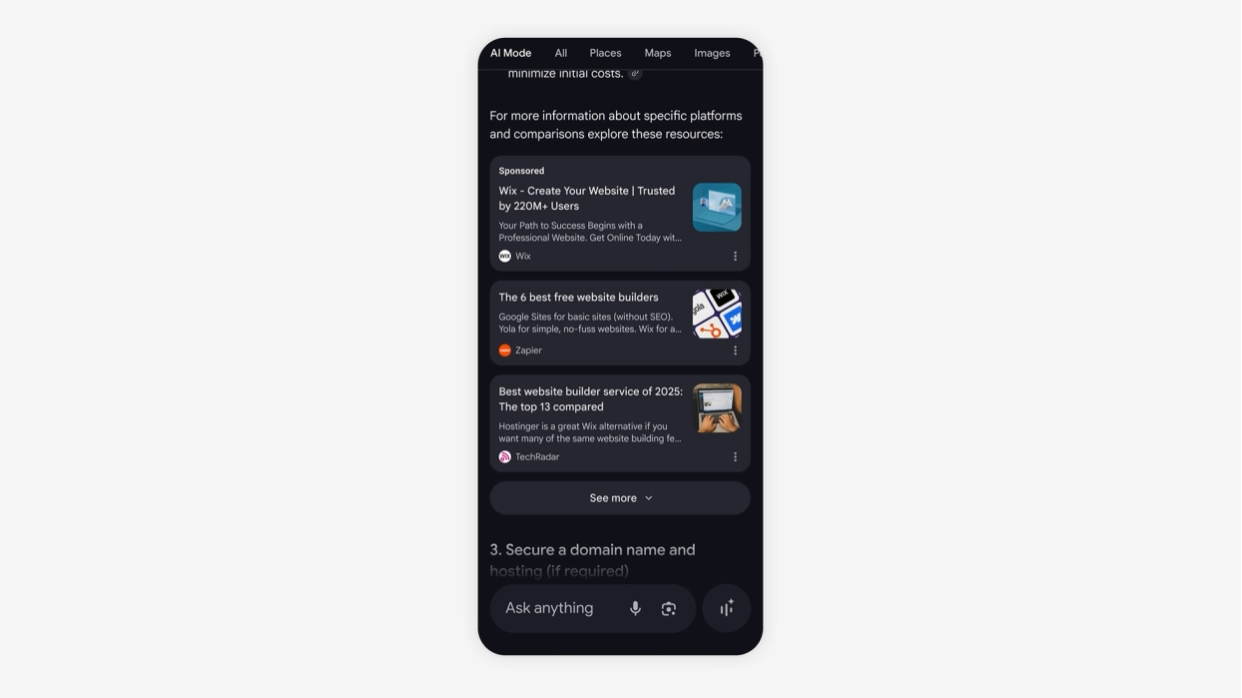
Based on the current architecture, ads will likely appear below AI responses rather than within them. The "aimba" (AI Mode Bottom Ads) timing parameters suggest a placement after the AI answer completes. This preserves editorial separation between AI content and advertising.
Can I run Google Ads campaigns targeting AI Mode today?
Not specifically. Current Google Ads campaign types may serve impressions when users interact with AI Mode, but there are no dedicated AI Mode campaign settings yet. The attribution system is tracking these interactions, so you can analyze AI Mode touchpoints in your conversion data.
How will AI Mode ads affect my current search advertising ROI?
This depends on how Google prices AI Mode placements and whether they cannibalize traditional search volume. If AI Mode captures high-intent queries that previously went to standard search results, expect some budget reallocation. The upside is that AI Mode users often have clearer intent, which could improve conversion rates for well-targeted ads.
Should I focus on organic AI visibility or wait for paid options?
Both matter. Organic citations in AI responses build credibility and capture zero-click research traffic. Paid placements will let you appear for queries where you lack organic presence. The most effective approach combines AEO strategy for organic visibility with readiness to test AI Mode ad placements when they launch. Start by learning how to get cited in Google AI Overviews above organic results to build your organic foundation.
Google AI Overviews does not use top-ranking organic results. Our analysis reveals a completely separate retrieval system that extracts individual passages, scores them for relevance & decides whether to cite them.
Google AI Mode is not simply a UI layer on top of traditional search. It is a completely different rendering pipeline. Google AI Mode runs 816 active experiments simultaneously, routes queries through five distinct backend services, and takes 6.5 seconds on average to generate a response.
We breakdown how how AI Overviews work and currently contain zero embedded ads, and traditional SERP ad slots remain intact above and below. But the technical groundwork for future monetization is already visible in the code.
We analyzed 1k+ traffic flows from Gemini's web interface. Understanding these mechanisms helps you optimize your content for AI visibility because Gemini treats structured data, entity relationships, and third-party validation as core signals when deciding what to cite.