How Google AI Overviews ads work today and where they're heading
We breakdown how how AI Overviews work and currently contain zero embedded ads, and traditional SERP ad slots remain intact above and below. But the technical groundwork for future monetization is already visible in the code.
Ex-Stanford AI Researcher specialising in search algorithms and LLM optimisation.
July 28, 2026
Published: January 23, 2026|Updated: July 28, 2026
7 mins
TL;DR
AI Overviews currently display as organic content with no embedded ads
Traditional top and bottom SERP ads remain fully preserved alongside AI content
Google prioritizes AI content visibility, rendering it at 61ms before ad tracking completes at 68ms
A unified tracking system links ad impressions to specific AI-enhanced searches via adview_query_id
Privacy Sandbox integration (Attribution Reporting API) suggests preparation for cookieless ad tracking
Shopping and commercial queries do trigger AI Overviews, but product ads stay separate
Google renders AI Overviews ~7 milliseconds before its ad tracking even fires. That timing gap, discovered through traffic analysis of Google's search infrastructure in January 2026, reveals a clear priority: user experience first, advertising second. AI Overviews currently contain zero embedded ads, and traditional SERP ad slots remain intact above and below. But the technical groundwork for future monetization is already visible in the code.
This article breaks down exactly how Google handles advertising alongside AI Overviews today, what the tracking systems reveal about attribution, and what signals suggest about where ads in AI search are heading. If you're still getting up to speed on AI Overviews, our guide on how to get cited above organic results covers the fundamentals.
We analyzed Google's network traffic for AI Overview queries using an 8-layer inspection method. The findings give a clear picture of how advertising currently works in this new search format.
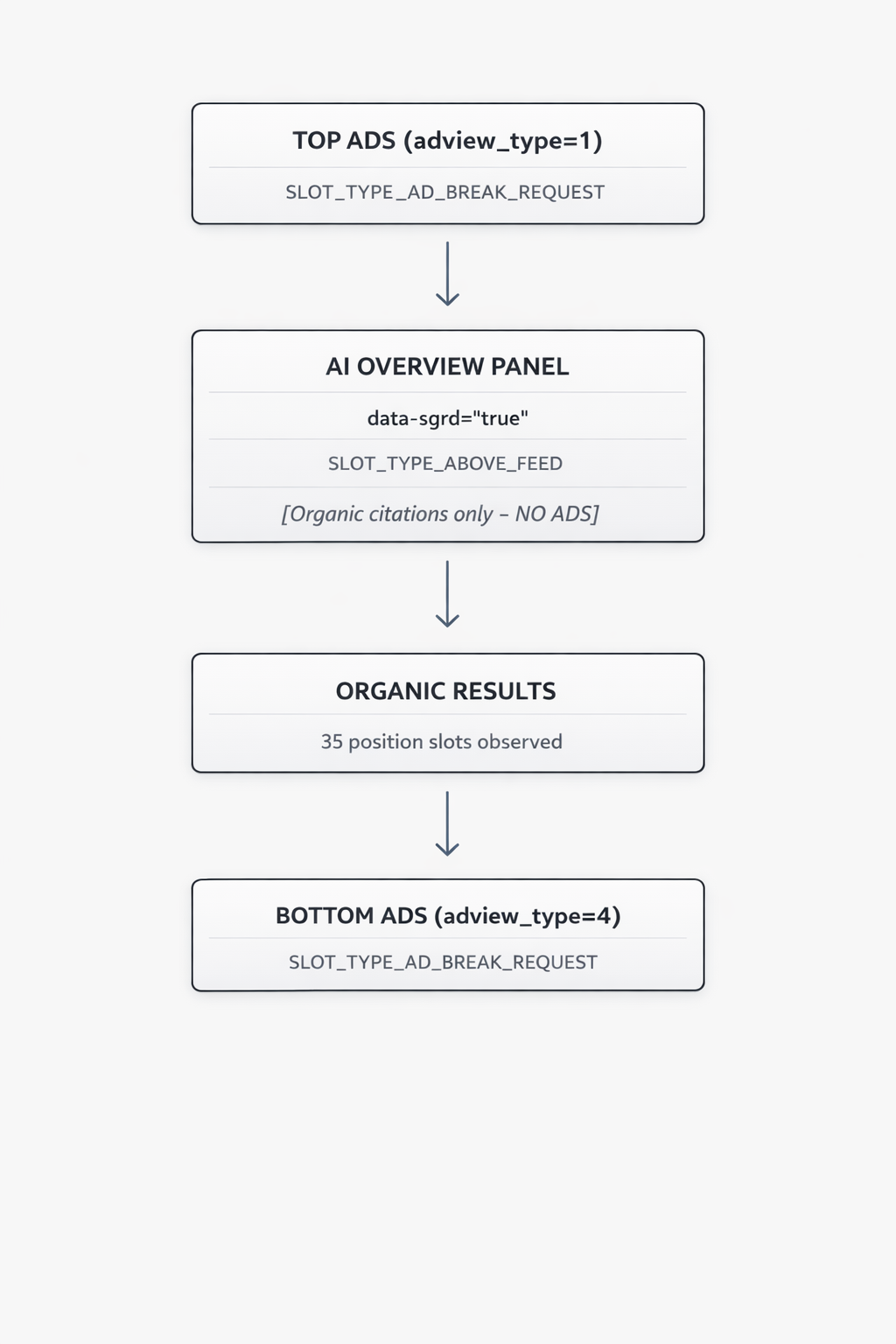
The current SERP hierarchy looks like this:
The AI Overview slot uses SLOT_TYPE_ABOVE_FEED in Google's internal architecture. This places it prominently above organic results but keeps it separate from the ad slot system, which uses SLOT_TYPE_AD_BREAK_REQUEST. According to Google's official AI documentation, AI Overviews are designed to provide "an AI-powered overview of key information" while still directing users to supporting sources.
Key finding: No ads appear inside AI-generated content. The data-sgrd attribute clearly marks AI content boundaries, and no ad containers exist within those boundaries.
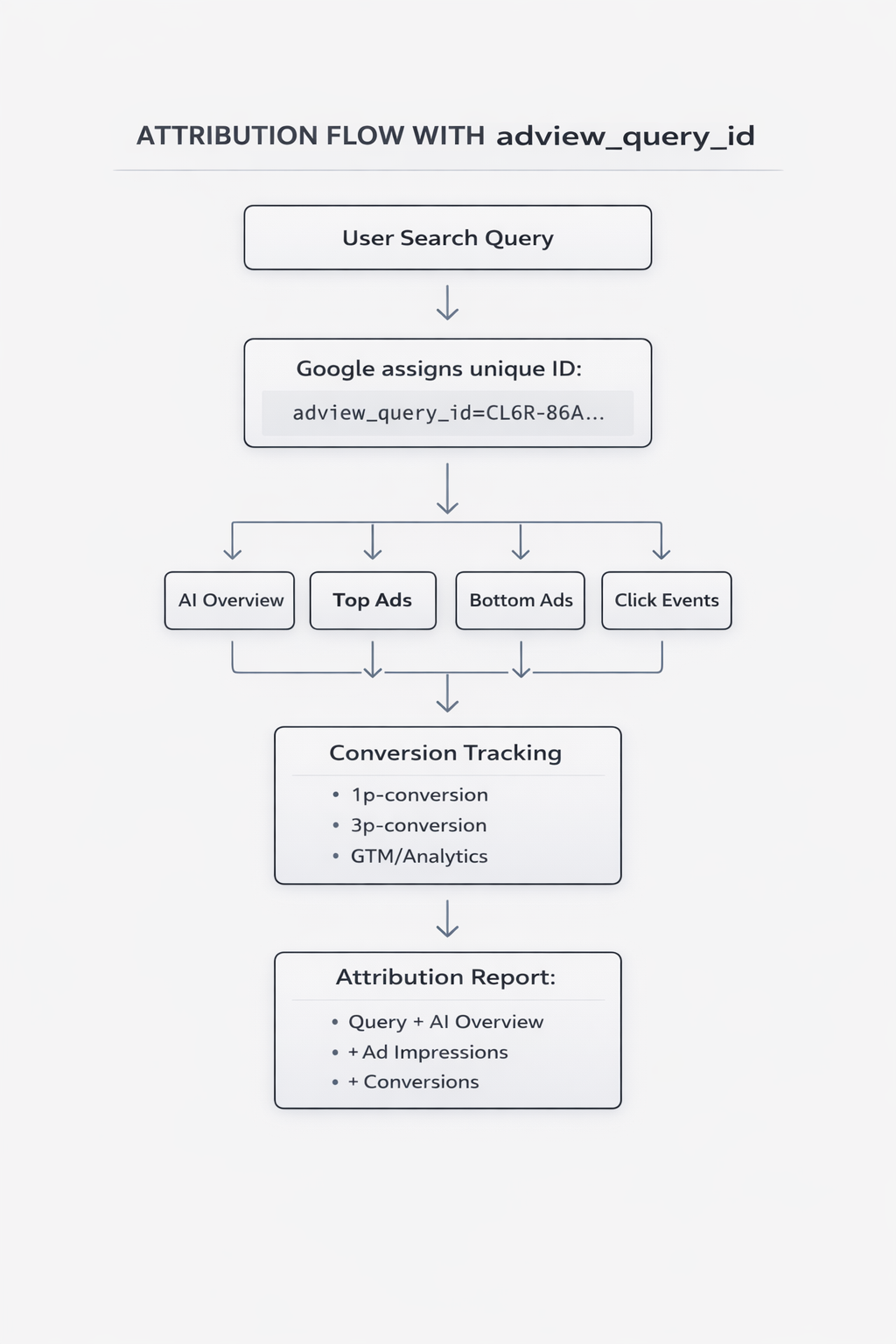
Google's attribution system connects ad impressions to specific AI-enhanced searches through a parameter called adview_query_id. This creates a direct link between what someone searched, whether they saw an AI Overview, and which ads appeared.
Example tracking flow:
When someone searches "should i buy airpods pro from amazon or apple store directly," Google assigns a unique query ID like CL6R-86AlpID.... This ID follows the user through:
Analytics and Tag Manager (GTM-16521530460, AW-16521530460)
The system tracks 8 specific images from ads in that session, distinct from the 15 total images on the page.
This matters for marketers because: Google can attribute conversions specifically to searches that included AI Overviews. They're building the measurement infrastructure to prove (or disprove) whether AI content helps or hurts ad performance. For a deeper dive into attribution models for AI-driven advertising, see our guide on measuring ROI on AI agent ads.
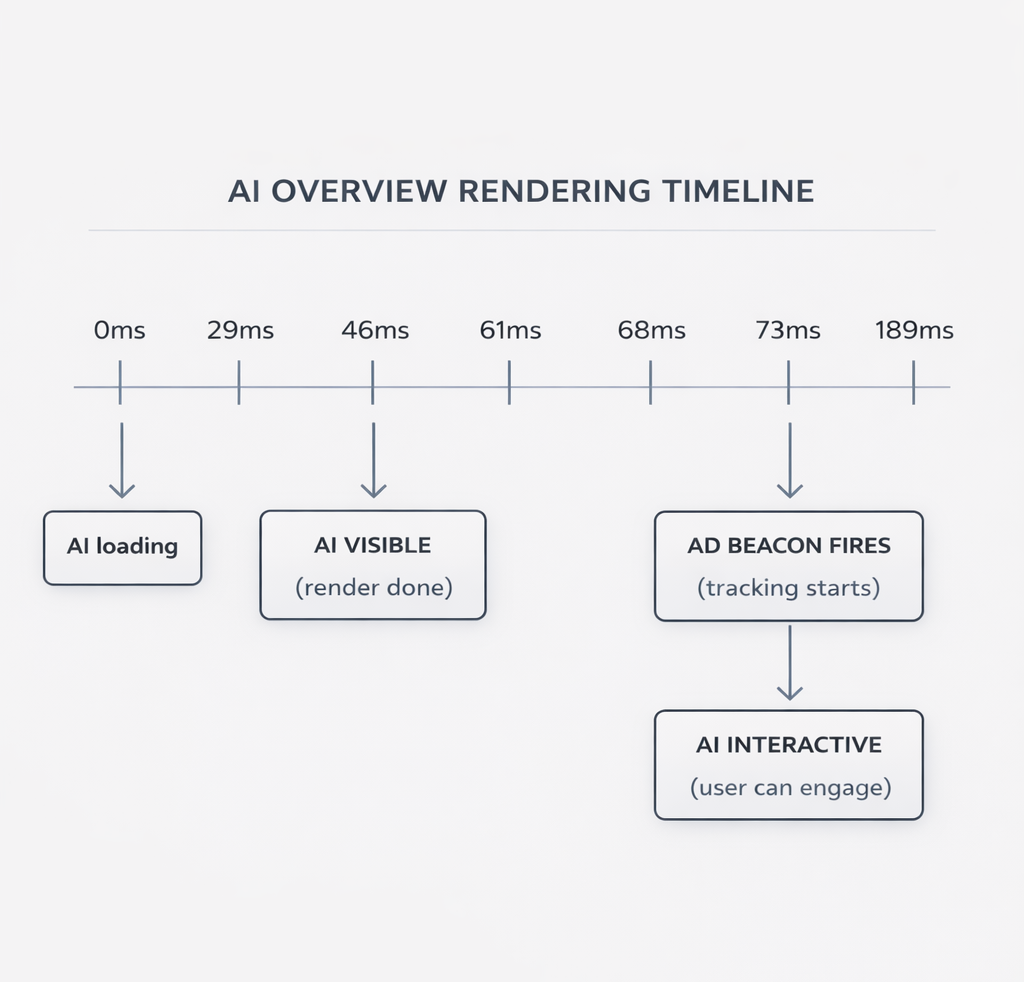
Here's something interesting from the timing data. Google prioritizes getting the AI Overview visible before ad tracking finishes:
AI Overview starts loading: 29-46ms
AI Overview render complete: 61ms
First-party ad beacon fires: 68ms
AI Overview interactive: 73-189ms
This 7-millisecond gap (61ms vs 68ms) might seem small, but it reveals intent. Google wants users to see the AI answer first. The advertising system catches up after. This prioritization aligns with Google's stated goal of providing helpful information first, as outlined in their Search quality guidelines.
For brands focused on AI visibility, this confirms that appearing in AI Overviews gives you prime positioning that loads before ads even finish tracking.
Based on the technical architecture, several things stand out:
1. Slot system already supports ad insertion
The same infrastructure that positions AI Overviews (SLOT_TYPE_ABOVE_FEED) includes 38 SLOT_TYPE_AD_BREAK_REQUEST slots in a typical search session. The technical foundation for inserting ads exists.
2. Unified experiment tracking
Both AI Overviews and ads share the same Operation Platform ID (opi=89978449). Google runs unified A/B tests across AI and advertising systems. When they experiment with ads in AI content, they can measure the impact precisely.
3. Attribution already connects AI to conversions
The adview_query_id system means Google knows exactly which conversions came from sessions with AI Overviews. If they want to sell "sponsored AI answers" or "featured citations," the measurement infrastructure is ready.
4. Async ad loading is in place
The AsyncDataService endpoint (ogads-pa.clients6.google.com) loads additional ad data via gRPC after the initial page loads. For now, it returns empty responses for most queries. But the pipeline exists to inject ads dynamically.
Short-term: AI Overviews remain ad-free real estate. Getting cited there means appearing in a format where users see your brand before any advertising. This is valuable positioning that Google has clearly prioritized based on render timing.
Medium-term: Google will almost certainly monetize AI Overviews eventually. The question is how. Based on the tracking infrastructure, "sponsored citations" or "featured answers" seem more likely than banner ads jammed into AI text. We cover the emerging paid landscape in our complete AI agent ads platform guide.
Long-term: Share of voice in AI search will likely become a paid and organic hybrid, similar to how traditional SERPs evolved. Brands that establish strong citation rates now will be better positioned when paid placements arrive. To understand how this shift compares to traditional search advertising, read AI agent ads vs traditional search ads: the B2B strategy shift.
Before Google introduces paid placements that complicate the picture, establish your baseline:
Map your key queries - Identify the 50-100 questions your buyers ask AI assistants about your category
Audit current citations - Check which queries cite your brand in AI Overviews
Calculate your share of voice - What percentage of relevant AI answers mention you?
Track over time - AI citation rates shift as models update their training data
Most brands find they're cited in fewer than 10% of relevant AI answers. That means 90%+ of potential visibility is missing, and currently, you can capture it through content alone without paying for ads. For a comprehensive approach to improving your citation rates, see our 15 AEO best practices guide.
Google's technical infrastructure reveals a window of opportunity that won't stay open forever. Here's how to act on these findings:
Prioritize AI Overview citations now. The 61ms render timing confirms AI content loads before ad tracking even fires. Getting cited in AI Overviews puts your brand in front of users before any paid placements appear.
Expect sponsored citations, not banner ads. The adview_query_id attribution system and 38 ad slots suggest Google will monetize through "featured answers" or "sponsored citations" rather than traditional display ads. Plan content that could compete in both organic and paid AI placements.
Build your measurement baseline before paid arrives. Google already tracks conversions tied to AI-enhanced searches. Map your current citation rate across 50 to 100 key queries so you can measure the impact when paid options launch.
Treat AI Overviews as a distinct channel. Traditional SERP ads remain fully preserved (top and bottom positions). AI visibility is additive, not a replacement for your existing paid search strategy.
Prepare for cookieless AI attribution. Privacy Sandbox integration (Attribution Reporting API, Browsing Topics) in the ad code means Google is building AI search monetization for a post-cookie world. Ensure your attribution stack can handle these new signals.
Move faster than enterprise competitors. The async ad loading pipeline (AsyncDataService) currently returns empty responses. That infrastructure is waiting for activation. Brands that establish strong citation rates now will have an advantage when paid placements go live.
Are there ads inside Google AI Overviews right now?
No. As of January 2026, AI Overviews contain zero embedded advertising. Traditional SERP ads appear above and below AI content, but the AI-generated section itself is ad-free.
Do commercial queries still trigger AI Overviews?
Yes. Shopping queries like "should I buy X from Y or Z" and product comparisons both display AI Overviews with active ad tracking in the traditional SERP positions.
How does Google track conversions from AI-enhanced searches?
Google uses an adview_query_id parameter that links specific searches to ad impressions and conversions. This allows them to attribute conversions to sessions that included AI Overviews.
Will Google eventually put ads in AI Overviews?
Almost certainly. The technical infrastructure (slot systems, async ad loading, unified tracking) is already in place. The question is timing and format, not whether it will happen.
How can I track my brand's visibility in AI Overviews?
Monitor specific queries manually or use AI visibility tools that track share of voice over time. Discovered Labs offers AI visibility audits that show exactly where your brand appears and where gaps exist.
Google AI Overviews does not use top-ranking organic results. Our analysis reveals a completely separate retrieval system that extracts individual passages, scores them for relevance & decides whether to cite them.
Our team analyzed network traffic from Google AI Mode in January 2026. The capture included 547 Google flows and over 1,300 total requests during AI Mode sessions. The findings paint a clear picture of how Google is preparing to monetize AI-generated search results.
Google AI Mode is not simply a UI layer on top of traditional search. It is a completely different rendering pipeline. Google AI Mode runs 816 active experiments simultaneously, routes queries through five distinct backend services, and takes 6.5 seconds on average to generate a response.
We analyzed 1k+ traffic flows from Gemini's web interface. Understanding these mechanisms helps you optimize your content for AI visibility because Gemini treats structured data, entity relationships, and third-party validation as core signals when deciding what to cite.