How ChatGPT shopping works and where ads might fit in
ChatGPT's shopping feature pulls product data from Google Shopping but displays zero advertising today. We captured and analyzed over 1.1 million product tracking parameters from shopping sessions to confirm this. Products appear based on relevance to your query, not paid placement.
Ex-Stanford AI Researcher specialising in search algorithms and LLM optimisation.
January 23, 2026
Published: January 23, 2026|Updated: January 23, 2026
9 mins
TL;DR: ChatGPT's shopping feature pulls product data from Google Shopping but displays zero advertising today. We captured and analyzed over 1.1 million product tracking parameters from shopping sessions to confirm this. Products appear based on relevance to your query, not paid placement. For brands focused on AI visibility, this means optimizing for organic recommendation is your path forward right now. When ads eventually arrive later this year, strong organic positioning will give you a head start.
ChatGPT processed over 1.1 million Google Shopping product references in the sessions we analyzed. Zero of them were sponsored. But thats about to change.
This article breaks down exactly how ChatGPT's shopping system works based on deep traffic inspection of the feature in January 2026. You will learn what triggers product recommendations, where the data comes from, how the technical architecture operates, and what advertising opportunities may emerge. If you are a CMO, demand gen director, or marketing leader watching AI reshape how buyers research products, understanding this infrastructure gives you a strategic advantage.
The technical architecture behind ChatGPT shopping#
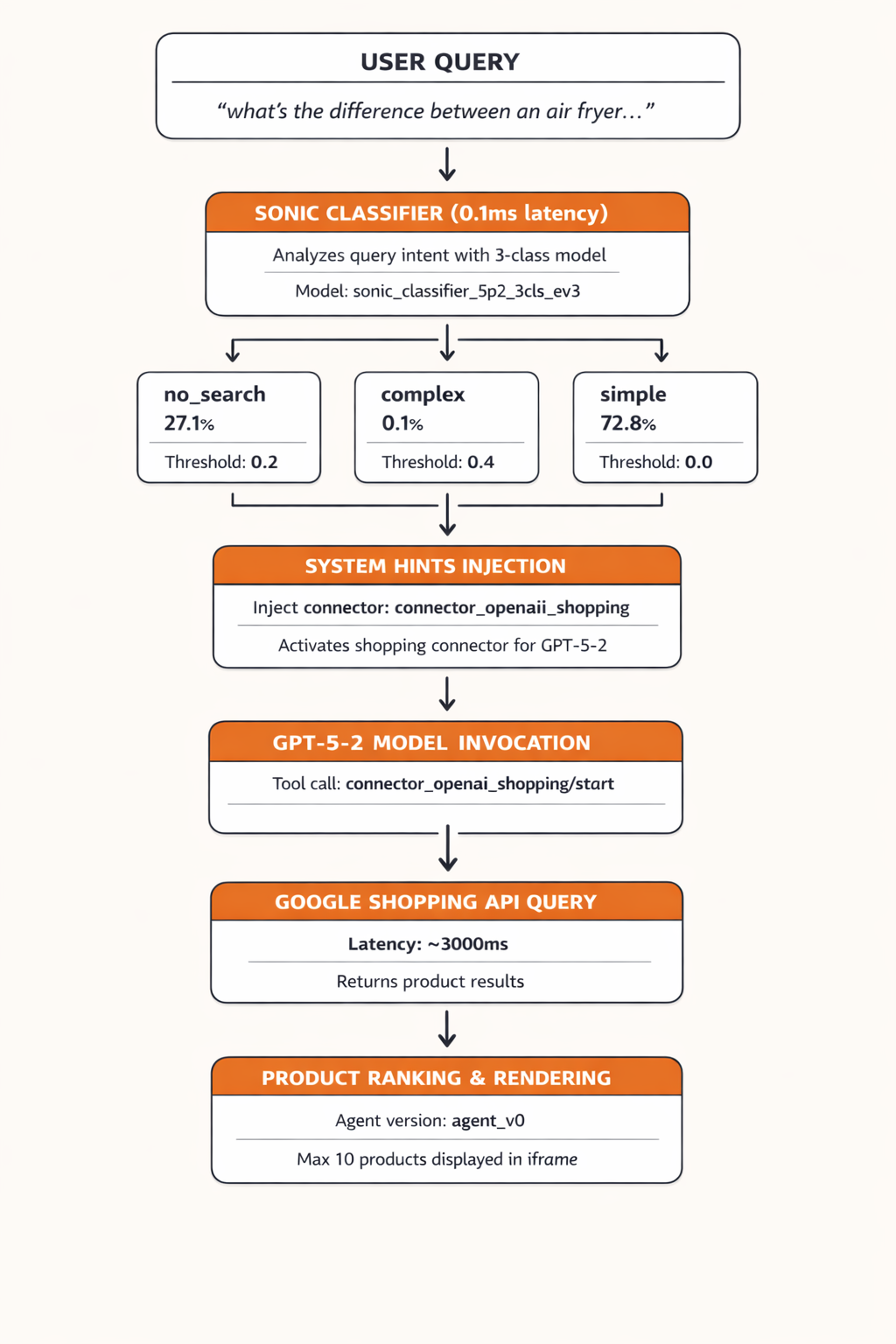
ChatGPT's shopping feature runs on a system OpenAI calls connector_openai_shopping. This is a first-party connector built entirely by OpenAI, not a third-party integration or plugin.
Here is how it works end-to-end:
The entire flow from query to product display takes approximately 3.5 seconds. The classifier runs in 0.1 milliseconds. The bottleneck is the Google Shopping API call at roughly 3 seconds.
The Sonic classifier decides what happens to your query#
Before your query even reaches the GPT-5-2 model, ChatGPT's browser code analyzes it using a 3-class probability system called Sonic. Our traffic capture revealed the exact configuration:
The classifier outputs three probabilities:
no_search: Query does not need external data (threshold: 0.2)
complex_search: Query needs deep research (threshold: 0.4)
simple_search: Query needs basic web search (threshold: 0.0)
Shopping intent detection happens separately. When the client detects shopping intent, it injects a special hint: connector:connector_openai_shopping. This hint overrides the normal search classification and tells GPT-5-2 to activate the shopping connector.
Most of the product URLs in ChatGPT shopping contains a distinctive tracking parameter: srsltid=AfmBOo*. This prefix is unique to Google Shopping. This proves ChatGPT is pulling from Google Shopping's product database. The integration gives ChatGPT access to:
Product names and descriptions
Pricing from multiple merchants
Real-time availability status
Direct links to merchant websites
Product images and specifications
However, ChatGPT is not displaying Google's paid Shopping ads. It is using the underlying product catalog without the advertising layer. This distinction matters for brands. Your products can appear in ChatGPT shopping through your Google Shopping presence, but you cannot currently pay for placement.
Products appear in ChatGPT responses using a specific encoding format. The model embeds product JSON using Unicode markers:
\ue200product\ue202{product_json}\ue201
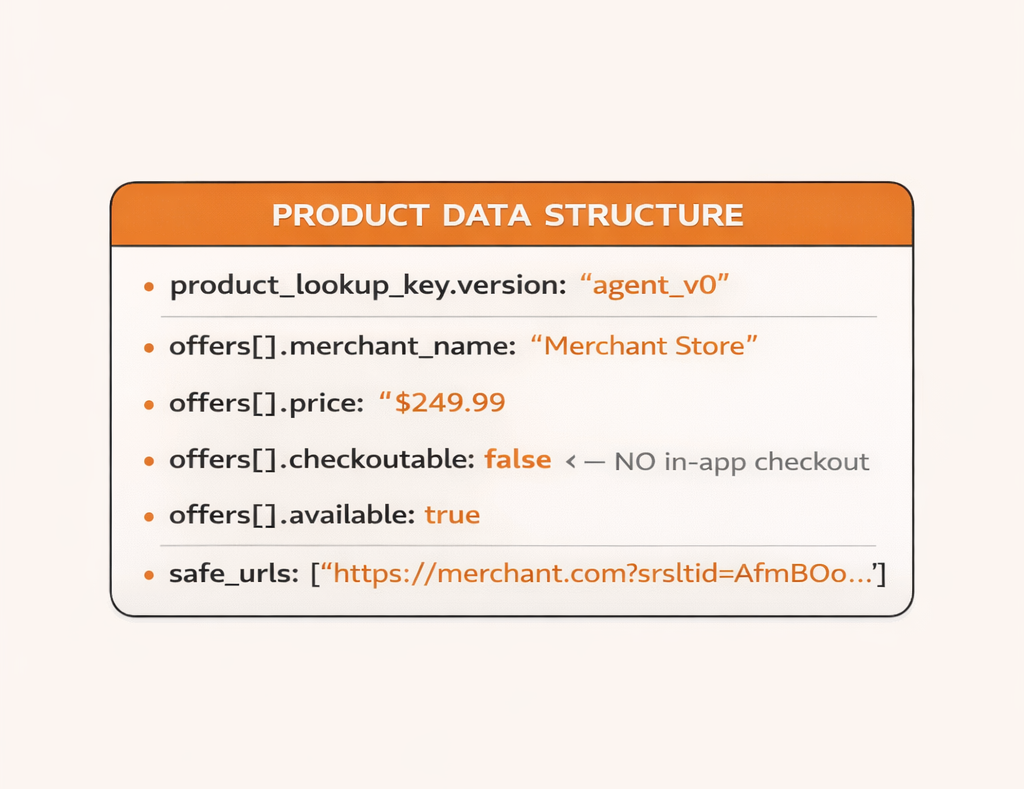
Here is what a product payload looks like in the streaming response:
The checkoutable: false parameter is significant. ChatGPT does not support in-app purchases. Every transaction happens on the merchant's website. This creates a pure referral model.
Zero advertising exists in ChatGPT shopping today#
Our traffic analysis searched for every major ad network, tracking pixel, and affiliate system. None were present.
The only outbound tracking is utm_source=chatgpt.com on product links. This allows merchants to see traffic originated from ChatGPT, but it generates no revenue for OpenAI.
This finding matters because it confirms ChatGPT shopping is currently a level playing field. But this is about to change with the launch of ads this coming month.
Product selection in ChatGPT shopping happens through a multi-stage process. The system extracts user requirements, queries Google Shopping, then ranks results based on relevance.
When you ask a shopping question, an internal tool called Mercury extracts your specifications:
Query: "best robot vacuum under $300 for pet hair"

Extracted requirements:
- Product type: Robot vacuum
- Price constraint: Under $300
- Use case: Pet hair cleaning
These requirements become the search parameters for the Google Shopping API query.
Products with complete, accurate Google Shopping listings
Competitive pricing that matches user-specified budgets
High availability across multiple merchants
Clear product descriptions that match natural language queries
There is no way to pay for better placement today. Your citation rate depends entirely on how well your product information matches user intent. This represents both a challenge and an opportunity for brands that optimize their product data effectively.
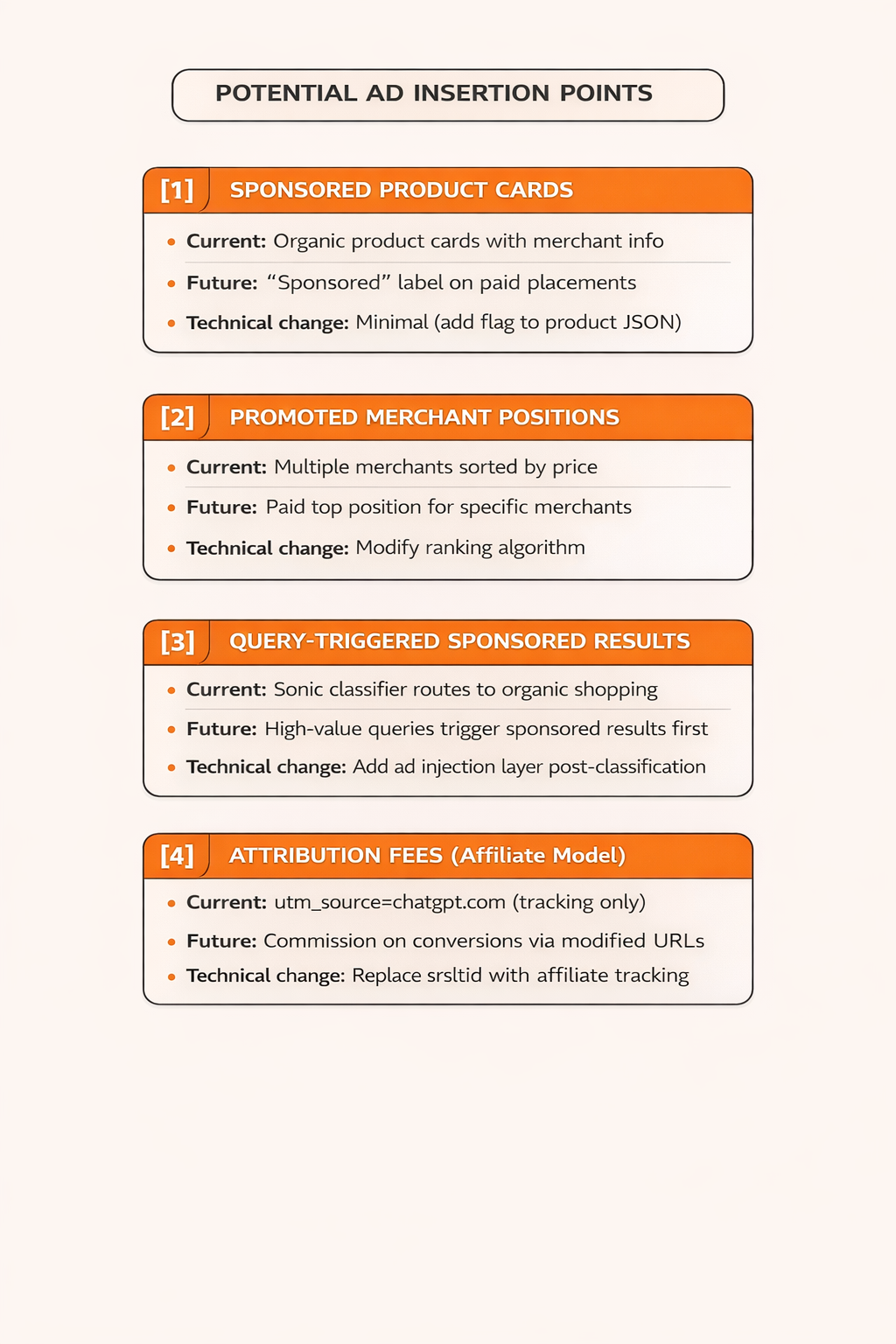
The shopping widget already displays products in card format with merchant attribution. Adding a "Sponsored" label would require minimal technical changes. Google already has the advertiser relationships and bidding infrastructure through Shopping ads. A partnership could enable Google Shopping ads to flow directly into ChatGPT's interface.
Currently, ChatGPT shows multiple merchant offers for each product with price often determining order. A promoted merchant could pay for top position or visual emphasis without changing the underlying product selection. This mirrors how Amazon handles the "Buy Box."
The Sonic classifier already categorizes queries by intent in 0.1 milliseconds. High-value commercial queries (electronics, appliances, software) could trigger sponsored results alongside organic recommendations. This mirrors how Google Search evolved from pure organic results to a mix of ads and organic listings.
The simplest monetization model would be referral fees from merchants. The tracking infrastructure already exists. OpenAI could negotiate percentage fees on conversions similar to affiliate programs. The challenge is attribution across devices and time windows.
ChatGPT shopping represents a new surface area for product discovery. Unlike Google Shopping where ad spend dominates visibility, ChatGPT currently rewards product quality and data accuracy over budget.
ChatGPT pulls from Google Shopping's database. Problems in your product feed flow through to ChatGPT recommendations. Check for:
Incomplete product descriptions
Outdated pricing
Missing images or specifications
Availability mismatches
Your Google Merchant Center data quality directly impacts AI visibility.
2. Optimize product descriptions for natural language
Traditional SEO keywords matter less than clear, complete descriptions. AI models match products to queries using semantic understanding. Focus on:
Clear use cases and benefits
Specific technical specifications
Comparison points against alternatives
Common questions buyers ask
The goal is helping the model understand when your product is the right answer.
3. Build third-party validation
AI models weight external mentions when selecting products. Reviews on retail sites, Reddit discussions, and expert recommendations influence which products get surfaced. As discussed in our guide on how to get cited by ChatGPT, third-party validation signals credibility to AI systems.
4. Monitor your citation rate
Track how often your products appear in AI shopping results for relevant queries. This establishes a baseline before advertising potentially changes the dynamics. Our guide on measuring ROI on AI agent ads covers attribution approaches for this emerging channel.
5. Prepare for the advertising transition
When ads arrive in ChatGPT shopping, brands with strong organic presence will have advantages:
Established product data quality
Existing citation history
Understanding of what queries drive product visibility
Baseline metrics for measuring ad lift
The window for organic-only optimization will not last forever. Brands that establish AI visibility now will have an advantage when paid placement becomes available.
The technical findings in this analysis point to specific strategic actions you can take right now.
The Sonic classifier runs client-side in 0.1ms. Shopping intent is determined before your product data even reaches the model. This means product descriptions must immediately signal relevance to buying queries. Optimize for natural language purchase intent, not just keyword matching.
Google Shopping is the single data source. Every product URL contains the srsltid=AfmBOo tracking parameter confirming Google Shopping as the origin. Your Google Merchant Center presence is your ChatGPT shopping presence. Fixing data quality issues there fixes them everywhere.
Ranking favors relevance, price match, and availability over ad spend. With zero advertising infrastructure detected, ChatGPT currently surfaces products based on how well they match user requirements. Brands with accurate pricing, complete specifications, and high availability will outperform competitors with bigger budgets.
The architecture has clear ad insertion points ready. Sponsored product slots, promoted merchant positions, and query-triggered ads could all be implemented with minimal technical changes. When advertising arrives, brands with established organic positioning will have baseline metrics to measure ad lift against.
User feedback creates real-time personalization. The system re-ranks products after every 3 dislikes within a session. This means first impressions matter, but so does ensuring your product genuinely matches the query intent. Misleading listings will get filtered out quickly.
Attribution tracking exists but generates no revenue today. The utm_source=chatgpt.com parameter means you can already measure AI-referred traffic in your analytics. Start tracking this channel now to build historical data before the competitive dynamics shift.
How ChatGPT shopping compares to other AI platforms#
ChatGPT is not the only AI system with shopping capabilities. Google's Gemini and other platforms are building similar features. Understanding the differences helps prioritize your optimization efforts.
The key distinction is data sourcing. ChatGPT pulls from Google Shopping, which means your existing Google Merchant Center presence transfers to ChatGPT visibility. Other platforms may use different data sources. Our comparison of ChatGPT ads vs Google Gemini ads explores these differences in detail.
For B2B products, the shopping feature is less relevant since it focuses on consumer goods. However, the underlying architecture of connectors and system hints applies to other ChatGPT features. B2B marketers should watch AI agent ads for B2B marketing for industry-specific strategies.
The broader context is that AI platforms are becoming commerce channels. Our overview of ChatGPT as an ads platform covers what marketers need to know about this shift.
Discovered Labs specializes in AEO for B2B companies, helping teams dominate answers in their vertical across ChatGPT, Perplexity, and other answer engines.
We use internal tools to audit where you appear (and where you are missing) in AI-generated answers. Then we help close those gaps through targeted content and third-party mention strategies.
The shopping feature analysis in this article comes from our traffic inspection methodology. We apply the same depth of analysis to understand how AI platforms cite (or miss) your brand in their responses.
No. As of January 2026, ChatGPT shopping displays zero advertising. Our traffic analysis found no ad networks, no affiliate tracking, and no sponsored content markers. Products appear based on relevance to the user query, not paid placement.
Where does ChatGPT get its product data?
ChatGPT pulls product information from Google Shopping's API. The srsltid=AfmBOo* parameter on all product URLs confirms this integration. This includes product names, prices, merchant availability, images, and direct purchase links.
How does ChatGPT decide which products to recommend?
A classifier called Sonic analyzes your query in about 0.1 milliseconds to determine intent. If shopping intent is detected, ChatGPT activates its shopping connector, queries Google Shopping, and the GPT-5-2 model selects relevant products to display. Selection is based on query relevance, price match, availability, and merchant diversity.
Will ChatGPT add advertising to shopping?
OpenAI has not announced advertising plans, but the technical infrastructure could support it with minimal changes. Sponsored product slots, promoted merchant positions, and referral fees are all technically feasible. Financial pressure from the company's growth trajectory makes advertising a likely future addition.
How can I get my products to appear in ChatGPT shopping?
Optimize your Google Shopping listings since ChatGPT sources data from there. Ensure accurate product descriptions, competitive pricing, high-quality images, and complete merchant information. Beyond that, build third-party validation through reviews and mentions that AI models can reference when selecting products.
How fast is the ChatGPT shopping experience?
The complete flow from query to product display takes approximately 3.5 seconds. The Sonic classifier runs in 0.1 milliseconds. The GPT-5-2 model generates its first token in about 1.8 seconds. The Google Shopping API query is the bottleneck at roughly 3 seconds.
Google AI Overviews does not use top-ranking organic results. Our analysis reveals a completely separate retrieval system that extracts individual passages, scores them for relevance & decides whether to cite them.
Our team analyzed network traffic from Google AI Mode in January 2026. The capture included 547 Google flows and over 1,300 total requests during AI Mode sessions. The findings paint a clear picture of how Google is preparing to monetize AI-generated search results.
Google AI Mode is not simply a UI layer on top of traditional search. It is a completely different rendering pipeline. Google AI Mode runs 816 active experiments simultaneously, routes queries through five distinct backend services, and takes 6.5 seconds on average to generate a response.
We breakdown how how AI Overviews work and currently contain zero embedded ads, and traditional SERP ad slots remain intact above and below. But the technical groundwork for future monetization is already visible in the code.