Podcast
SEO Is About to Change Forever (and nobody even realises)

Liam Dunne
Host
January 4, 202616:30
SEO is about to change forever and most marketers have absolutely no idea what's coming. Everything you know about driving growth from organic search [music] is getting turned upside down. And I know this because my team and I spend all day every day obsessing over growth from organic search. We're actively working with many B2B companies. [music] And what we're seeing is that the strategies that were crushing it just last year have suddenly stopped working. Right now there are massive shifts happening that almost nobody is talking about yet. But if you can catch these changes early and adjust what you're doing now, you're going to be light years ahead [music] while your competitors are still completely clueless. Like one of our B2B SAS clients that does over $30 million in [music] ARR, who recently went from 575 high intent trials per month to over 3.5K [music] in just 7 weeks from AI search alone. And another series B client who saw their search visibility increase by 600% within the first 2 months of taking this approach. This really is your big chance to be an early adopter in this AI era. Distribution shifts do not happen like this very often. So, in this video, I'm going to walk you through the eight biggest shifts that are reshaping SEO as we speak. I'll be breaking down what's actually changing, why it matters for your business, and exactly what you need to do to stay ahead of the curve. So, the first and most important shift is this. Search engine optimization as we've known it for the last 20 years is finished. It's done. The new game is answer engine optimization, also known as AEO. For two decades, the entire goal was to rank number one on a page of 10 blue links. Right? That was the whole game. But now the goal is completely different. It's to become the cited source inside personalized AI generated answers. Ultimately, the recommended solution from these AI assistants. Now, why does this even matter so much? Well, because this isn't some small incremental change. This isn't another Google update. This is a fundamental disruption to how buyers discover and evaluate vendors and companies are already seeing the impact of this with website traffic [music] dropping through the floor since AI overviews and assistants have grown in usage. And honestly, here's the brutal truth. If you are not the source of the answer these buyers are getting, then you're probably not even being considered as an option. [music] And this is the complete paradigm shift. Being number one on Google does not guarantee you'll be cited by an AI. In fact, there's research out there that shows only about a 50% overlap between top organic listings and the sources that AI models actually site. So, what do we do about this? Well, first you have to stop obsessing over keyword rankings. These are a vanity metric in this AI era.
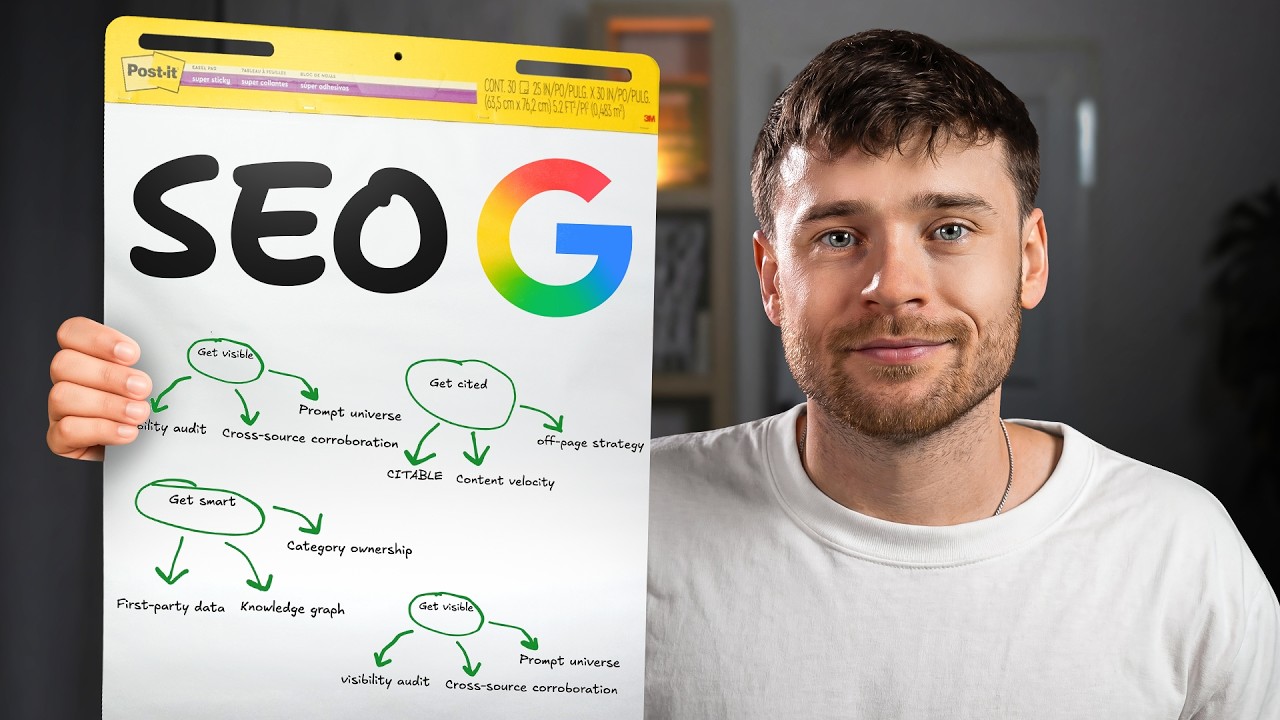
Instead, you need to start tracking three new metrics. The first one is mention rate. How often is your brand being mentioned in relevant answers? The second is citation rate. This is how often is your content being used as a source to form those answers. And finally, share a voice. What is your overall dominance in the answers for your category? Second, go and audit your top 20 commercial intent queries. The action you need to take is stop looking at your rank trackers and start looking at what's happening [music] in these AI systems. Go type your most important problem aware query into ChatG and just see what it says. Is it you? Is it your competitor? That's going to become your new baseline and inform your AEO strategy. All right, the second shift is that the concept of domain authority is breaking. For years, SEO was a game of acquiring backlinks to build up this score. But that model is becoming obsolete. Now, you might be asking why. Well, because AI models don't really care how many backlinks you've got. They care about expertise and providing the most accurate and trustworthy answer to users. And they determine that trust through crosssource corroboration because really they want to avoid giving hallucinated answers back to the user.
And so the new goal isn't just to get back links. It's to have consistent verifiable information about your brand across multiple trusted third-party sources. And honestly, this is the reason why you might see a competitor with a lower domain authority dominating in AI answers. The AI is thinking in terms of entities and concepts, not just keywords. and it's trying to figure out who is the expert on a given topic and who's going to provide me the most relevant answer to the user. Think about it this way. If multiple third party sites say your pricing is $99 a month, but on your own website it's $79, then the AI is going to trust the consensus over you. Your website has historically been like a resume where you say great things about your company, but AI search is now verifying those claims by researching if others are saying the same things. So, how do we prepare for this? Well, first you need to create what we call a set of facts document for your company. This is a single source of truth for your pricing, your features, your key differentiators, everything about your company. Second, you need to audit your presence on all of those third party sites, G2, Capterra, Reddit.
You need to be asking, is the information in these places consistent with this set of facts document? And if it's not, then you need to go out there and fix it. Because this isn't just about building back links anymore. It's about building a network of trusted third-party validation which is going to help you satisfy the grounding process that these models go through. Now, this brings me to the third shift which is how we approach content strategy. The old SEO model was about ranking for a handful of high volume head terms, but AI search there is no fixed rank. Two users can ask the exact same query and get a completely unique personalized answer based on their context, their history, and their situation. The new game is about capturing the longtail of AI queries and you do that through what we call intent architecture. This means deliberately structuring your content to satisfy not just the primary question but all of the adjacent intents that an AI's query fanout process is going to explore when it's conducting web searches. Let me quickly explain. So when a buyer prompts chat GBT, the model doesn't just answer that one question.
It performs what's called query fan out. It breaks that initial prompt into several different semantically varied subqueries about [music] pricing, alternatives, integrations, use cases, limitations, you name it. And if your content only answers that primary question, then you're probably going to be invisible for 80% of the buyer's actual research journey. And your competitors who have mapped out their full prompt universe are the ones capturing all of those valuable citations. How do we build this citation mode? Well, first you have to map your prompt universe. This is the entire universe of prompts your ideal customer is putting into AI assistance across all of their different situations and use cases. You have to think way beyond keywords. Think in full sentences like, "I'm a marketer at a 50 person startup with a $100,000 budget and I'm looking for project management software that integrates with Slack." Second, for every single piece of content you create, you need to deliberately cover those adjacent intents. [music] talk about alternatives, the integrations, the use cases, the pricing, the limits, and the benchmarks.
Everything to try cover that prompt universe. And third, you need to ideally structure your content in a classic hub and spoke model where each article captures multiple query variations. And so that way, when the AI's query fan out happens, it still lands on you and not a competitor's site. This is absolutely key to ensuring most citations within these AI answers are coming from you. Okay, shift number four. This one is critical for anyone who has to justify their marketing budget. We need to talk about the dark funnel of AI and this new attribution model it requires. Here's the scenario. A prospect gets a recommendation for your company from Chat GBT, but they don't just click a link because that would make our lives too easy. Instead, they open a new tab and they go directly to your website or they just visit another time, maybe from a different device. Now, in your analytics like J4, where does that show up? Well, it's going to show in your reports as direct traffic. [music] The true source is completely invisible. And so, this is what we refer to as the dark funnel. And this is a massive pain point for every marketer who's under pressure to prove return on investment. Right? If you are unable to attribute leads and revenue to your marketing efforts, then you can't justify the budget. And so, what happens is it leads to underinvestment in the very [music] channel that is starting to drive highest intent traffic you can get. And so, what happens is companies go into a death spiral. So, what's the solution?
Well, you need to stop only relying on lastclick attribution. Start by tracking metrics like your branded search volume, your direct traffic, and your demo requests all in a single dashboard. Then keep an eye out for a lift in these metrics that somehow correlates with an increase in your AI mention rate, your citation rate, and your share of voice, which are going to be those leading indicators of your AI search performance. And honestly, on a much simple tactical level, you absolutely must add a how did you hear about us field to your demo and contact forms. Now, it's not perfect by any means, but it does give you qualitative data that will allow you to connect the dots. You have to stop trying to connect every lead to a single click. The buyer's journey is not this linear path that we think it is. All right, the fifth shift is a bit of a hot take, but it's something we're seeing prove out with our clients over and over again. This old model of publishing two to three blog posts a week on a few keywords is finished. In the world of AEO, content quantity actually matters and daily publishing is becoming a non-negotiable.
This is happening because you're no longer trying to rank a single page in a fixed position. Remember, AI models use passage level extraction. What this means is that each piece of content you publish could have five, maybe 10 different passage candidates. That's 10 different shots on target just from one article. Publishing a high volume of disconnected content just creates noise. But publishing a high volume of connected content, all built on a solid framework like our citable model, allows you to completely saturate a topic with expertise. And look, don't just take it from me. Look at what the most successful and fastest growing SAS companies are doing right now. Ramp is publishing anywhere between 5 to 15 articles per day, and Shopify is doing the exact same. And these aren't companies just throwing crap at a wall and hoping it sticks, right? They understand that in the age of AI search, content volume is a massive strategic advantage. If you're still publishing 10 articles a month, then you are simply bringing a knife to a gunfight. So, how do we do all of this without sacrificing quality? Well, first, you need to batch your content production around your core topic pillars. Spend a whole month creating 20 pieces of content on one specific subtopic rather than one piece on 20 different topics. Second, you have to use an AI assisted human in the loop workflow. Let AI help with the efficiency, but have your experts overseeing everything for quality and accuracy. And every single piece of content must be based on a framework like Citable, which is going to make that content optimal for LLM retrieval.
And then third, focus on shipping and iterating. Get the content live, see how it performs in the AI engines, and then refine it over time. Internally at Discovered Labs, we build a knowledge graph across all clients so we know exactly what content formats and topics perform best so that we can improve our winner rate. Okay, so this leads us directly into our sixth shift, the rise of entity optimization. The traditional SEO model of just optimizing for keywords is becoming obsolete. The new model is about making sure the AI assistants understand who you are, what you do, and how you fit into the broader knowledge graph of your entire industry. And this is so important because these AI models don't just look for keywords. They look for entities and the relationships between them. And if the AI doesn't understand your company as a [music] distinct entity with clear attributes and expertise, then it's just not going to know when to recommend you. And I found this is especially painful for B2B SAS companies that operate in these crowded categories where differentiation is absolutely critical. So how do you optimize for entities?
Well, first you need to create a comprehensive entity profile for your company. This means your company name, your founders, your mission, your product categories, your target industries, your key differentiators, and any notable achievements you have. Second, you need to use structured data or schema markup on your website to explicitly tell the AI about all of these attributes so you're not leaving it to chance or making it hard for them. And third, you need to explicitly build entity relationships. You do this by mentioning and linking to other relevant entities in your content. Things like your competitors, complimentary tools or alternatives, industry leaders. This is all going to help the AI understand where you fit into the entire ecosystem. Your website needs to become a knowledge base, not just a content site with baseless games that are bias in your favor. These AI models, they need to understand what you are, not just what you write about. Now for shift number seven. This is really where you can build a defensible mode long term. AI models are absolutely drowning in generic regurgitated content. What we call AI slop. The content that gets cited and the content that wins is going to be the content that contains unique verifiable information that can't be found anywhere else. This means your first party data. So things like customer insights, your internal benchmarks, your product usage stats is now your single most valuable AEO asset.
And this happens because AI systems are designed to find the most authoritative original source for any claim. If you're just repackaging information that exists elsewhere, then you're competing with everyone else who has that exact same information. But if you have unique data like conversion benchmarks from your own platform or industry research that you've conducted or anonymized insights from your customers, then you're going to become the original source that AI has to site. This is one of the best ways smaller companies can beat larger competitors in AI search. It's not about budget. It's not about domain authority. It's about having unique information that's relevant to customers. So, how do you leverage this? Well, first you need to audit what first party data you actually have access to. Look at your product usage data, your customer survey results, your internal benchmarks or insights from the sales conversations that you're having. Second, you need to create content that surfaces this data in a citable format. That means specific numbers, a clear methodology, and dated findings from your research. And then third, you need to use the answer grounding component of the citable framework. Back up every single claim with original data so these AI models can verify it and cite it with confidence. AI models are looking for original sources. If your content is just repackaging what everybody else is saying, then you're going to be invisible. Your first party data is your unfair advantage. All right, let's bring it home with the eighth and final shift, and this is a big one. The future of SEO is not just about your own content. In fact, [music] your website is probably only 20% of the battle. The other 80% is about being cited and mentioned across the entire web. AI models are increasingly looking at where your brand, your products, and your experts are being mentioned and cited by trusted third parties. This is earned media and it's becoming a critical ranking factor.
You can't control what the AI sees if you only publish on your own website. You have to be visible and cited across industry publications, podcasts, analyst reports, YouTube videos, forums, communities, and other authoritative sources. And the way to do this effectively is with a two-pronged approach. First of all, your off- page strategy has to be informed by the AI visibility audit we did in step four. If there's a clear pattern of what sites are being cited for your competitors, then we need to prioritize those. This is the single biggest factor that traditional SEO teams and agencies are getting wrong. If your AI search strategy is not being informed by AI answers, then it's not an AI search strategy. It's likely just SEO with a different label. Okay, so second, you have to be in the places that AI is known to favor. We know that ChatGpt loves Reddit. So you need to have a deliberate Reddit strategy if you want to succeed on ChatGpt. We also know that these models trust G2 and Capter Terra. So you should be running quarterly review campaigns. [music] And ideally, if you have the correct notability, then you should create or improve your Wikipedia page with neutral cited facts.
Your off- page strategy cannot be random. It has to be deliberate. You have to build your citation network on the platforms that these LLM actually trust. Now, I've given you some solid advice for what you need to do here, but if you want to know exactly what to do step by step, and if you're serious about ranking for AEO and showing up in front of your customers in LLMs, then click here to go to the next video. This is by far my most comprehensive guide on this topic, and I break everything you need to know about how everything works behind the scenes and what you actually need to do as action steps. I'll see you there.
Podcast
Podcast
Podcast
Podcast
Podcast
Podcast