How Gemini ads work today (and what they might look like when activated)
Every time you open Google Gemini, five advertising SDKs load in the background and request ads from Google's servers. This matters for your AI visibility strategy because when Gemini ads turn on, the dynamics of AI-driven discovery will shift.
Ex-Stanford AI Researcher specialising in search algorithms and LLM optimisation.
July 28, 2026
Published: January 23, 2026|Updated: July 28, 2026
6 mins
TL;DR:
Gemini's free tier shows zero display ads in the chat interface today
Google monetizes through premium subscription upsells (Google One AI Premium)
Five advertising SDKs are loaded but returning null responses
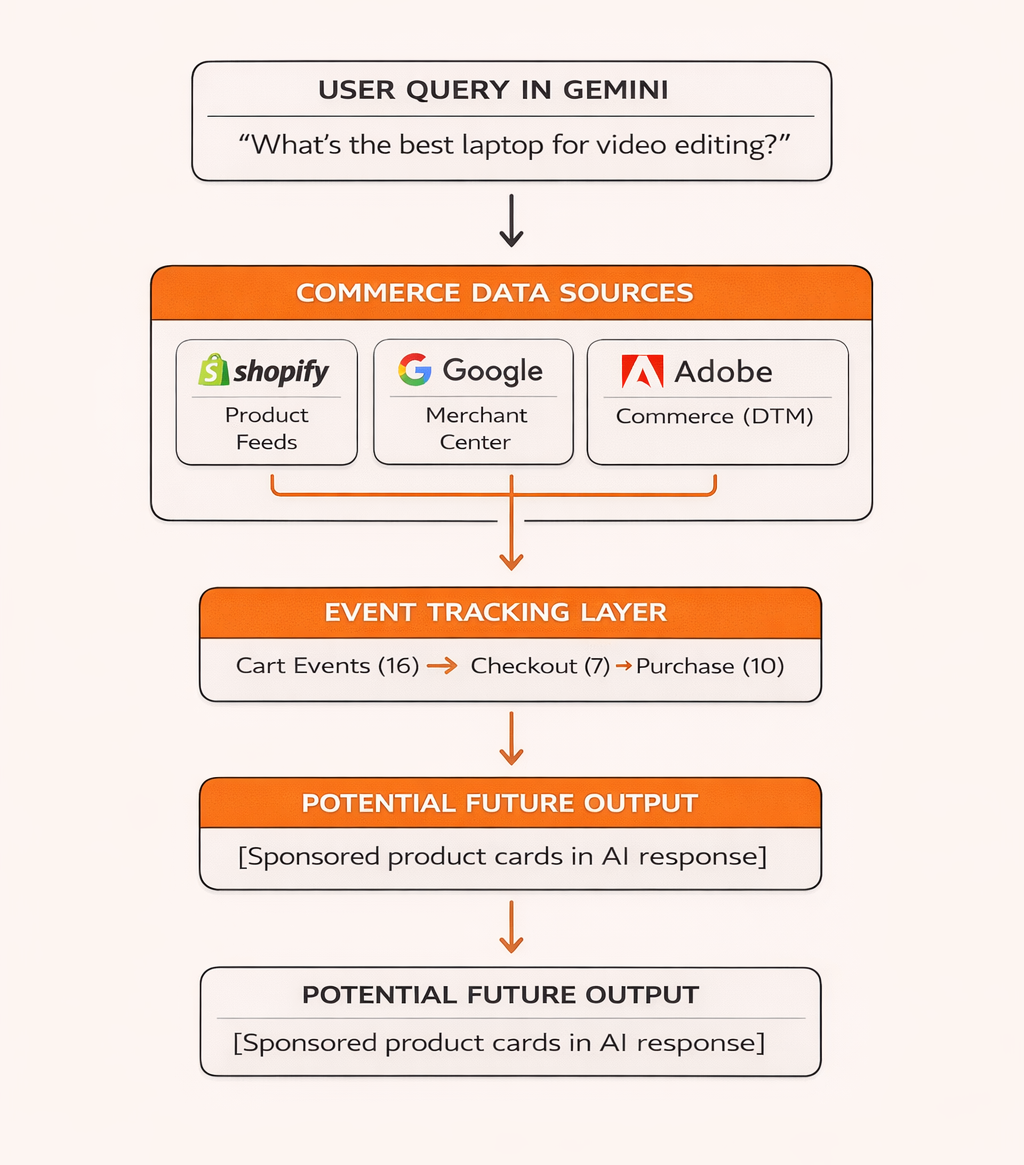
Commerce integrations with Shopify and Google Merchant Center are configured
When ads do activate, they will likely be query-based and highly contextual
Every time you open Google Gemini, five advertising SDKs load in the background and request ads from Google's servers. Every single time, those servers respond with nothing. Our January 2026 traffic analysis found fully configured ad infrastructure, commerce integrations with Shopify and Google Merchant Center, and over 5,000 feature flags ready for granular rollout. Google Gemini does not display ads today, but the machinery is built and waiting. (For a broader overview of AI ad platforms including ChatGPT and Gemini, see our complete platform guide for 2026.)
This matters for your AI visibility strategy because when Gemini ads turn on, the dynamics of AI-driven discovery will shift. Brands that have built citation authority now will be better positioned when paid placements enter the mix.
We ran an 8-layer traffic inspection on Google Gemini's free tier in January 2026. The findings paint a clear picture of Google's advertising intentions.
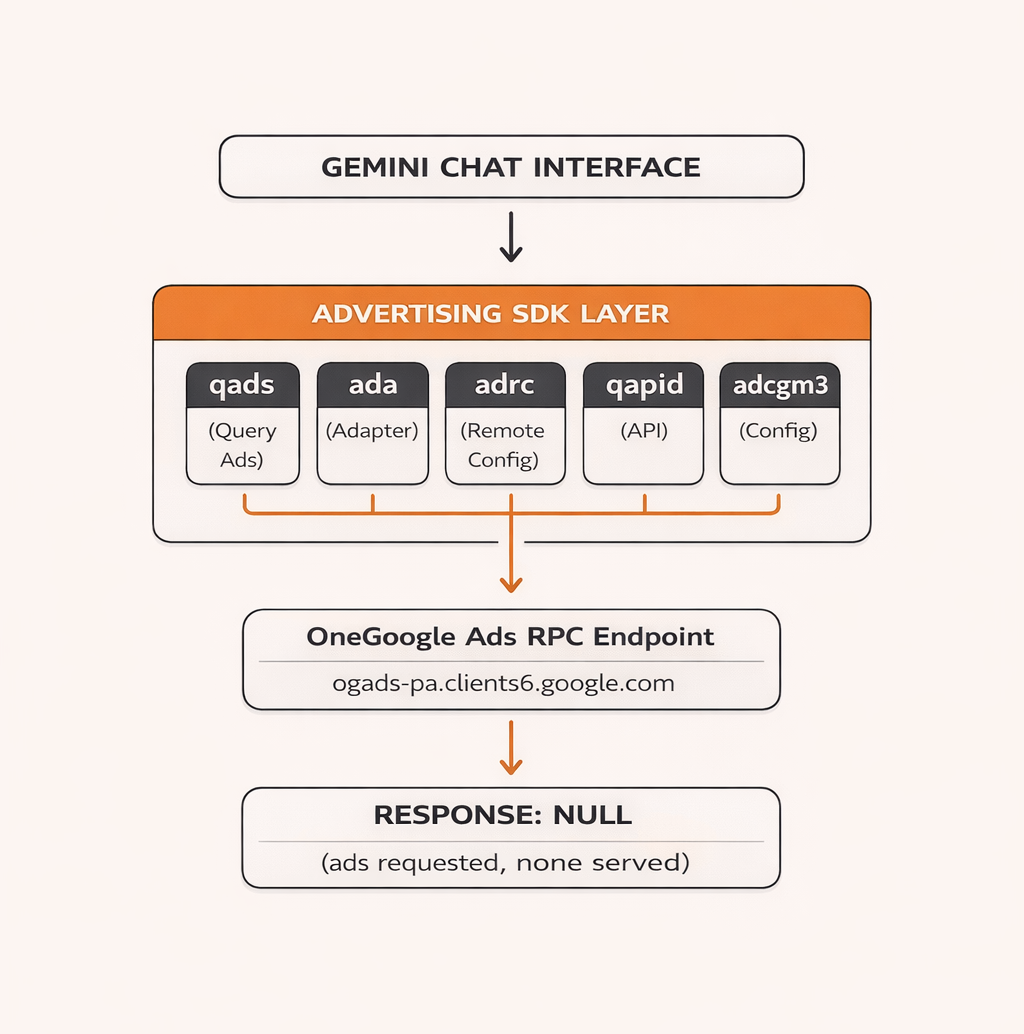
The ad infrastructure is present but dormant. Gemini loads five distinct advertising modules every time the interface opens:
Module
Purpose
qads
Query-based ad slot management
ada
Advertising adapter layer
adrc
Remote advertising configuration
qapid
API layer for ad operations
adcgm3
Third-generation ad configuration
These modules make calls to Google's OneGoogle Ads RPC endpoint (ogads-pa.clients6.google.com). During our analysis, every single response came back null. The system asks for ads, but none are served.
This is the digital equivalent of building a highway and installing all the toll booths but keeping the gates open for now.
Here's how the current Gemini ad infrastructure is structured:
Google's current approach to Gemini monetization is straightforward: upsell free users to paid subscriptions.
The free tier forces users to the cheapest "Fast" model through a flag called enforce_default_to_fast_version. Want the better "Pro" model with extended thinking capabilities? That requires Google One AI Premium at $19.99 per month.
Our traffic capture found 153 references to "upgrade" terminology and multiple RPC calls dedicated to upsell messaging. Campaign tracking parameters like utm_content=usage_limits_ultra_upsell reveal Google actively measures conversion rates from free to paid. According to Google's Q3 2024 earnings report, subscriptions and cloud services are key growth drivers, which helps explain this aggressive upsell approach.
Premium feature gates serve as conversion incentives:
Google Calendar integration
Gmail access
Google Docs connection
Drive file access
Full Workspace integration
All of these are disabled in the free tier. The message is clear: pay for premium or accept limitations.
Based on the infrastructure we observed, here's how advertising in Gemini will likely function.
Query-based ad serving. The presence of the "qads" (Query Ads) module suggests ads will be triggered by specific user queries. Ask about "best CRM software for small business" and you may see relevant promoted results.
Contextual relevance through personal context. Feature flags show Gemini can pull data from your Workspace documents, Search history, YouTube watch history, and code repositories. Ads could be targeted not just on the current query but on your broader context.
Native integration rather than banner intrusion. Google has a track record of integrating ads that feel like search results. Expect Gemini ads to appear as recommended solutions or featured answers rather than obvious display banners. Research from eMarketer suggests that native ad formats in AI interfaces see significantly higher engagement rates than traditional display formats.
Merchant Center product placements. The commerce infrastructure points to potential product recommendations within conversational responses. "Looking for running shoes under $150?" could surface sponsored product cards.
Geographic and segment-based rollout. The chunkTypes bitmap (a 5000+ character feature flag system) enables granular A/B testing. Google could activate ads for specific regions, user segments, or query categories without a global launch. This aligns with Google's stated approach to AI-powered advertising, which emphasizes gradual, performance-based rollouts.
The technical findings in this analysis point to specific actions you can take right now.
Audit your commerce readiness. Google's Shopify and Merchant Center integrations are already configured. If you sell products, ensure your feeds are optimized and your product data is structured for AI retrieval before sponsored placements go live.
Monitor feature flag rollouts. The 5,000+ feature flags in Gemini's chunkTypes system mean ads could activate for specific regions or user segments without warning. Set up monitoring to detect changes in your AI visibility by market.
Build citation authority while the ad SDKs stay dormant. The qads, ada, and adrc modules are loaded but inactive. This is your window to establish organic presence before paid placements compete for attention.
Prepare for query-based ad targeting. The qads (Query Ads) module suggests ads will trigger on specific queries. Map the high-intent questions in your category and create content that directly answers them now.
Strengthen third-party validation. When ads arrive, Google will likely use quality scores similar to Search ads. Brands with strong external mentions (Reddit, reviews, industry publications) will have better relevance signals and lower costs.
Track the subscription upsell patterns. Google's 153 upgrade references and premium feature gates reveal their current monetization playbook. Understanding this helps you predict where ads might first appear (likely the free tier, to offset user acquisition costs).
The absence of ads today does not mean you should wait to build your presence in AI systems.
Organic authority matters more before paid placements arrive. Once advertising enters AI chat interfaces, the dynamics shift toward whoever can pay the most. Building citation authority now, while the playing field favors content quality over ad budgets, gives you a structural advantage.
Third-party validation becomes your competitive moat. AI systems like Gemini pull context from across the web. Reviews, Reddit mentions, industry publications, and community discussions all influence what Gemini recommends. This validation is harder for competitors to buy their way past. Understanding how to measure this influence is critical—our guide to AI visibility KPIs that actually matter breaks down the metrics worth tracking.
Answer optimization skills transfer to ad environments. If and when Gemini ads launch, Google will likely use quality scores similar to their search ads. Brands with content that already performs well in AI systems will have better ad relevance scores and lower costs per engagement. This is why Generative Engine Optimization (GEO) has become essential for forward-thinking marketing teams.
The window for building organic AI authority without competing against paid placements is still open. That window will not stay open forever.
At Discovered Labs, we specialize in helping B2B SaaS teams build AI visibility before the advertising landscape shifts. Our approach focuses on three things: understanding where you appear (and don't appear) in AI answers today, creating content optimized for passage retrieval, and building third-party validation that AI systems trust.
If you want to understand your current share of voice in AI search before ads complicate the picture, we can help with a visibility audit that shows exactly where you stand.
No. As of January 2026, Google Gemini's chat interface does not display traditional advertising. The ad infrastructure is loaded but returns null responses. Google currently monetizes through premium subscription upsells to Google One AI Premium.
When will Gemini start showing ads?
Google has not announced a timeline. However, the presence of fully configured advertising SDKs, commerce integrations, and tracking infrastructure suggests the capability exists to activate ads at any time. The 5000+ feature flags in their chunkTypes system enable gradual rollouts by region or user segment.
How will Gemini ads affect my AEO strategy?
When ads arrive, they will likely appear alongside organic AI recommendations. Brands with established citation authority and strong third-party validation will be better positioned to compete. Building this foundation now, before paid placements enter the mix, creates a structural advantage. For a deeper look at how this landscape might evolve, read our predictions for AI agent ads from 2025-2027.
What data does Gemini use for personalization?
Our traffic analysis found feature flags enabling personal context from Workspace (Docs, Sheets), Search history, YouTube watch history, and code repositories. This suggests future ads could be highly targeted based on user context beyond just the immediate query.
Should I wait to invest in AEO until ads launch?
No. The best time to build AI visibility is before advertising complicates the playing field. Organic authority established now will carry forward and likely improve ad quality scores when paid placements arrive.
Google AI Overviews does not use top-ranking organic results. Our analysis reveals a completely separate retrieval system that extracts individual passages, scores them for relevance & decides whether to cite them.
Our team analyzed network traffic from Google AI Mode in January 2026. The capture included 547 Google flows and over 1,300 total requests during AI Mode sessions. The findings paint a clear picture of how Google is preparing to monetize AI-generated search results.
Google AI Mode is not simply a UI layer on top of traditional search. It is a completely different rendering pipeline. Google AI Mode runs 816 active experiments simultaneously, routes queries through five distinct backend services, and takes 6.5 seconds on average to generate a response.
We breakdown how how AI Overviews work and currently contain zero embedded ads, and traditional SERP ad slots remain intact above and below. But the technical groundwork for future monetization is already visible in the code.